
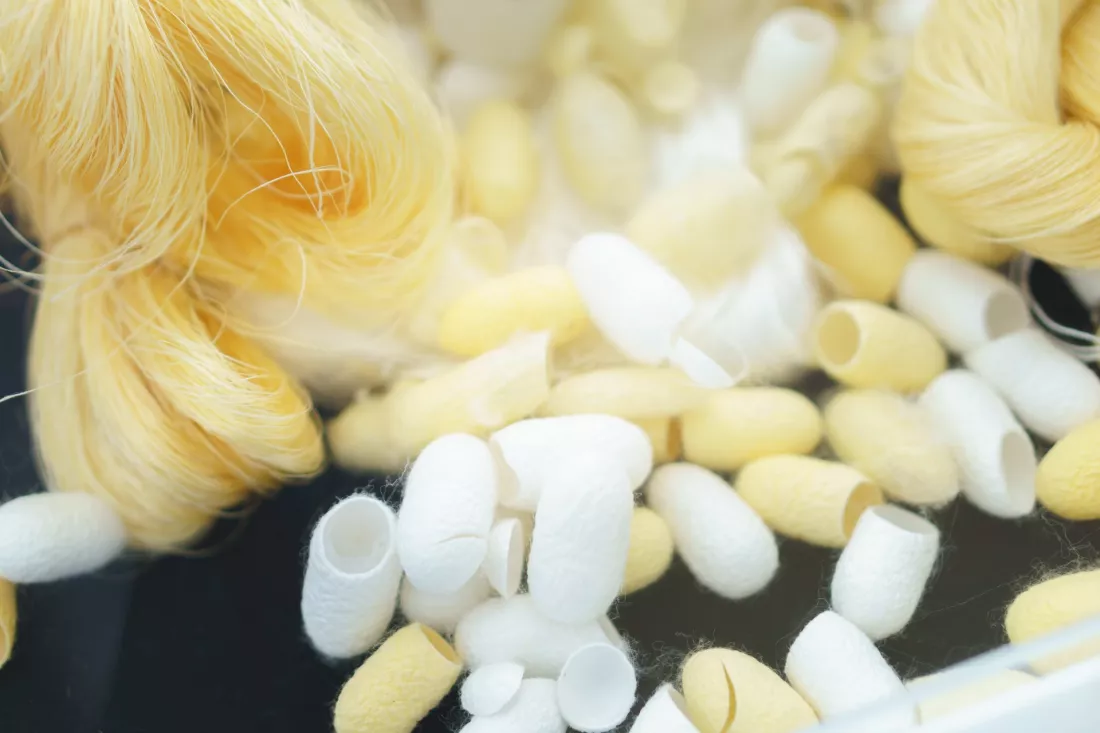
Bone marrow is hard to watch at work and even harder to recreate in the lab. A team from the University of Pavia therefore turned to a material few people would expect in medicine: silk from silkworm cocoons. It became a bioink used to print three-dimensional bone marrow models that are soft, strong and able to change colour. They are meant to help study bone disease, test drugs and produce platelets — and at the end you can check how much of this silky story you remember.
When you cut yourself, your body reacts in an instant: it produces platelets, which help the blood to clot. This process is led by megakaryocytes — giant cells hidden in the bone marrow. They make sure there is no shortage of platelets when they are needed.
The trouble is that this mechanism does not always work as it should. Leukaemia, viral infections or blood diseases can disrupt it, and the patient then becomes more vulnerable to injury. To search effectively for treatments, scientists need to understand well what happens in the marrow. And for that they need a reliable model.
This is where the SILKink project comes in, funded by the European Innovation Council. Its team built a bioink printing machine that uses silk as the base material. The device creates three-dimensional bone marrow models, which can then be seeded with living cells.
Such models make it possible to study bone disease and also to produce platelets ex vivo, that is, outside the body. This innovation could greatly enhance Europe’s medical research and lead to tailored drugs and personalised medicine — a key aim of the EU4Health strategy.
The project is coordinated by Alessandra Balduini from the Department of Molecular Medicine at the University of Pavia in Italy. As she says, “The goal of the project was using silk ink to understand if we can use this system to study drugs.”
Balduini and her team have developed bone marrow models for years, improving both their mechanisms and their clinical aspects. So they know exactly where the problem lies. A bioink has to provide enough structure for megakaryocytes to differentiate. Existing models do this quite well, but they have one flaw: they are not soft enough to closely mimic real bone marrow tissue.
That is no small matter. If the structure is not well represented, the cells become stressed and damaged, which changes their DNA. This masks the effect of the drugs being tested and makes it harder to identify good treatments.
The researchers chose a natural fibre harvested from the cocoons of domesticated silkworms. For this purpose silk has several strengths:
The result? Cells feel at home in such surroundings. Balduini explains: “Since we are mimicking the bone marrow, the cells are in a physiological-like state, so they have less DNA damage, they have less stress, less inflammation. So you can study the impact of a drug in a real system.”
One of the project’s major outcomes is the start-up Silk4B. The company commercialises the team’s advanced 3D bone marrow models and related silk-based products. They are bought by researchers, pharmaceutical companies and academics worldwide.
“We give the possibility to researchers to use bone marrow models they can really trust for their experiments,” notes the coordinator.
The team does not intend to stop there. The ink has gained the ability to change colour, which makes it easier to read any changes in the system. At the same time, work continues on a silk bone marrow platform that would allow platelets for transfusion to be mass-produced.
The researchers are also studying other applications for their models, for example culturing patient cells and seeing how they respond to drugs. They hope the system will eventually be used in clinical settings, though this is still a few years off.
This story shows well how close to each other different fields lie today. There is cell biology, work with materials, 3D printing, drug research and, in the end, business. An idea from a university department turned into a company whose products reach laboratories around the world.
If you study biotechnology, medicine, pharmacy or biomedical engineering, it is worth remembering one thing: a good research model can be as important as the drug itself. Without one, it is hard to honestly check whether a therapy works.
The SILKink project at the University of Pavia created a silk bioink used to print three-dimensional bone marrow models. They are soft and strong, so they imitate real tissue better and stress the cells less. They are used to study bone disease, test drugs and produce platelets, and they are sold by the start-up Silk4B. Clinical use, however, is still a few years away.
5 questions · one minute


 EN

 CS
 DE
 ES
 FR
 HU
 IT
 PL
 PT
 РУ
 SK
 TR
 УК
 AR
 中文