
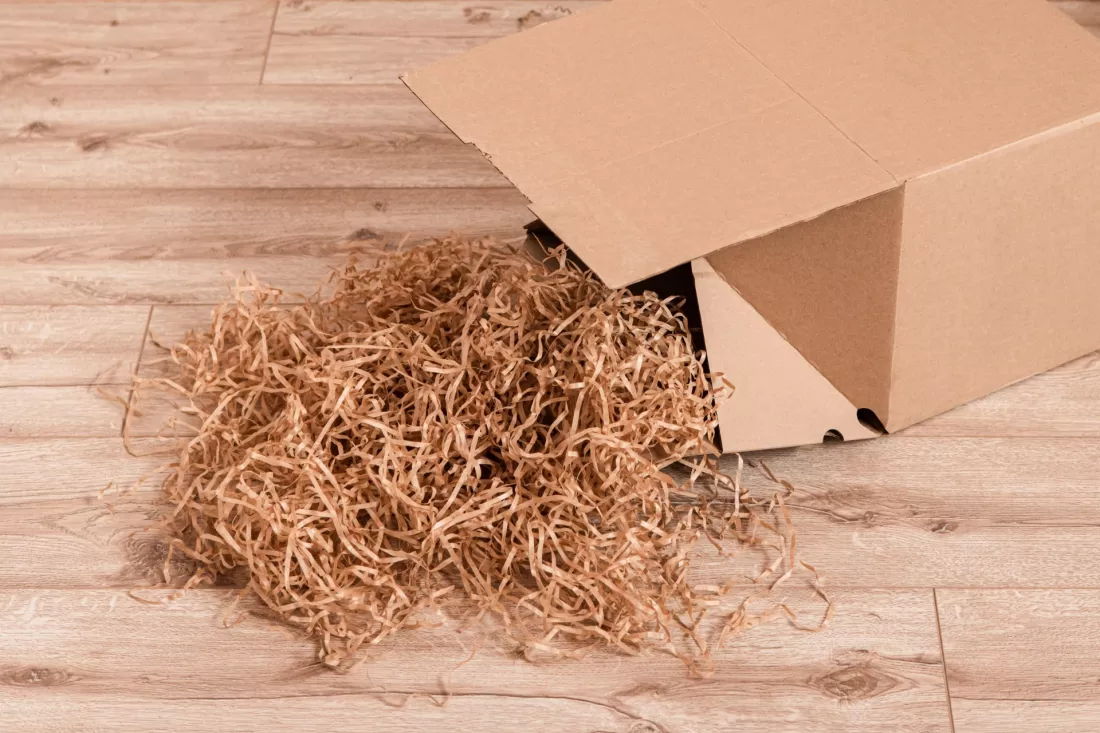
Bubble wrap is fun for a moment when you unpack a parcel, and then you are left with the problem of where to throw it. Estonian start-up RAIKU has a simple answer: a filler made from nothing but wood, with no chemicals, that can be composted. One cubic metre of raw material yields many times more packaging, and making it uses 90% fewer resources than producing paper. Here is how it works and what helped the company survive its early days – and at the end you can check how you handle packaging.
You order perfume for your sister or new headphones, open the box and pull out a handful of bubble wrap. A moment of fun popping the bubbles, and then the question of which bin it belongs in. This scene repeats itself in millions of homes, because packaging is one of the most visible components of household waste.
The scale of the problem is considerable. According to CORDIS, the average European produces around five tonnes of waste a year, and only 41% of it is recycled. Karl Pärtel, co-founder of the Estonian company RAIKU, puts it briefly: “We generate more waste than we can recycle”.
The European Union has set a goal: by 2030, 70% of packaging waste is to be recycled. That sounds ambitious, but it will not solve the problem. For years to come, millions of tonnes of packaging will still end up in landfills.
That is why some companies no longer ask only how to process waste better, but how not to create it in the first place. This is exactly how RAIKU, a cleantech start-up, thinks.
The Estonians have developed a cushioning material that is 100% natural and compostable. It is meant to replace plastics and other materials with a large carbon footprint – those used to make bubble wrap, but also bioplastics.
The recipe sounds surprisingly simple. As Pärtel says, “RAIKU’s packaging filling is made out of only one raw material – wood”. And he immediately adds: “No chemicals or additives are used in the production.”
The most interesting part is how economically the company handles its raw material. Pärtel explains that “we can turn one cubic metre of wood into 15 to 20 cubic metres of packaging”. On top of that, the process itself uses little energy and water. In short:
Pärtel comments on the third point like this: “Compared to paper production for example, we are able to reduce our resource consumption by 90 %.”
A good idea is only the beginning, though. For the new material to reach customers, extensive research and development was needed, along with scalable pilot lines. They were meant to convince future commercial partners that the technology would work not only in the laboratory.
Here the company met an obstacle familiar to anyone who dreams of running their own business. “We were in the classic start-up Death Valley,” Pärtel recalls. It is the stage at which private money is very hard to come by. The team knew its technology was promising, but at such an early stage, securing funding turned out to be a big challenge.
Help came from the European Innovation Council (EIC), which funded the RAIKU bio packaging project. Two years of support made it possible to develop a scalable and modular production technology. “This has given us a real opportunity to succeed,” Pärtel stresses.
The project ran from March 2024 to June 2026, and the EU contribution came to almost 2.5 million euros.
The results can already be seen in the numbers. RAIKU has around 100 clients in 20 countries, including brands such as LVMH and L’Oreal. Wooden filling is used to pack luxury perfumes, cosmetics, ceramics and electronic devices – fragile things that must reach the recipient in one piece.
The company has no intention of stopping. “We can now focus on our next scaling-up steps and how fast we can deploy our technology globally,” says Pärtel. The plan is concrete: “Next steps include establishing a large-scale factory, as well as deploying several micro-factories”.
The flexibility of the solution helps, because, as the co-founder points out, “Our modular technology can be deployed in different formats.” RAIKU has also secured money from private investors. The long-term goal? To make this material one of the main packaging materials in the world and displace energy-intensive plastics that are hard to recycle.
First, a lesson in ecology in practice. Pärtel sums up the company’s philosophy in these words: “A circular economy needs products that create no waste at all”, that is, ones that “become part of the natural cycle again”. It is a thought that will be useful to anyone who designs products or studies engineering or marketing.
Second, a lesson in entrepreneurship. The story of RAIKU shows that even a brilliant idea needs time, money and patience before it becomes a business.
The Estonian start-up RAIKU proves that parcel filling does not have to be plastic waste. Its material is made solely from wood, without chemicals, is compostable and needs 90% fewer resources than paper production. Thanks to EIC support, the company survived the hardest stage, won clients in 20 countries and plans to build a large factory.
5 questions · one minute


 EN

 CS
 DE
 ES
 FR
 HU
 IT
 PL
 PT
 РУ
 SK
 TR
 УК
 AR
 中文