
Plastics used in high-voltage cable insulation or in tough composites are designed so that once cured they never melt again. That is an advantage in daily use and a real headache when recycling time comes. The team of the European VIT project tested whether the two can be reconciled, and developed materials that signal damage by changing colour and can be reprocessed after heating — and at the end you can check how much of a materials engineer you have in you.
Thermoset plastics end up where strength matters: in composites, coatings and electrical insulators working under high voltage. Their greatest advantage is also their greatest drawback. They are designed so that, once cured, they neither melt nor flow. In service they are therefore stable, but when their life ends, it is very hard to use them again.
This problem was taken up by the team of the VIT project, funded by the European Union under the Marie Skłodowska-Curie Actions and coordinated by the University of Parma in Italy.
The researchers bet on vitrimers. These are polymers that behave like classic thermosets during use, but when heated they can change shape and can be repaired or reprocessed. The goal was clear: to develop materials that combine functionality with the possibility of recycling.
The work went on along several fronts at once. The researchers dealt with:
One of the key results is a set of materials that show stress, scratches, moisture or oxygen entry through a visible change in colour or fluorescence. This is down to special molecules called mechanophores.
“Thanks to our mechanophores or optical molecules, it is possible to detect damage, or the passage of humidity or oxygen, with the naked eye, because cracks, oxygen or humidity cause a clear change in colour,” explains project coordinator Roberta Pinalli.
In practice this means a chance to catch small scratches and microcracks before they turn into more serious damage. Importantly, in selected systems the optical response could be retained or restored even after the material was reprocessed. The signalling does not disappear with the first life cycle of the plastic.
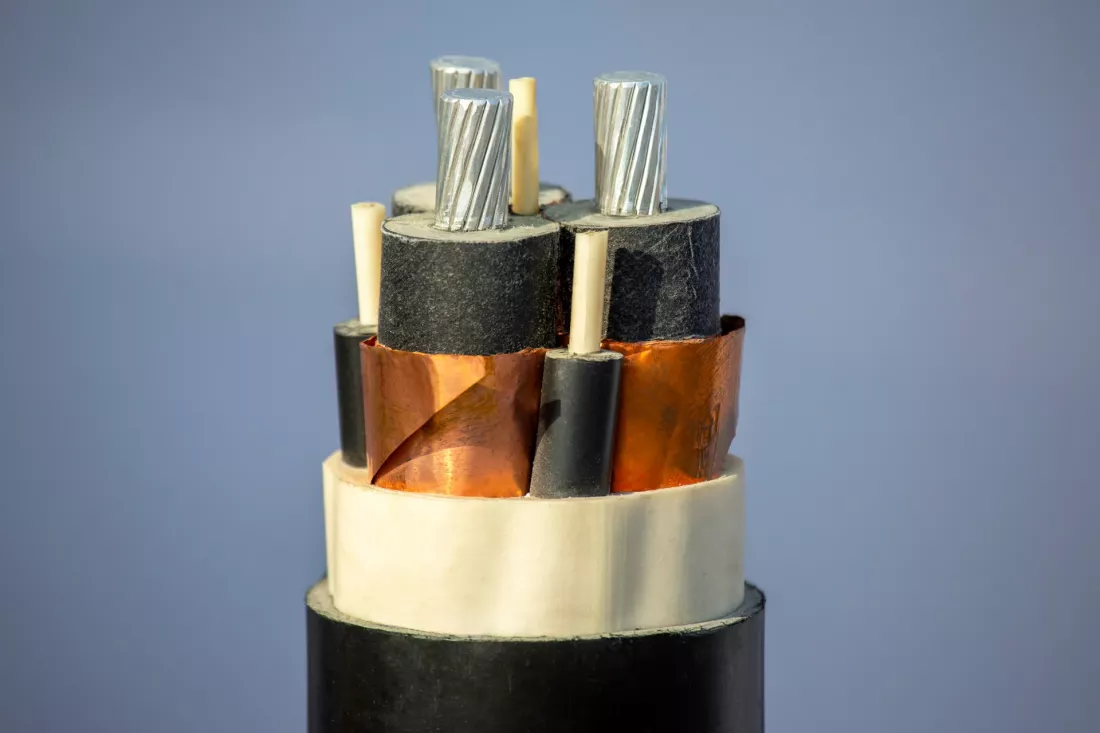
The project partners examined how the new materials would cope in high-voltage cable insulation, in composites and in thermoset parts. Cables are a good testing ground, because the cross-linked polyethylene widely used to insulate them is hard to recycle.
The team therefore tested polyethylene-based ionomers and vitrimer formulations as possible replacements. The result is promising: their electrical properties proved comparable to those of conventional materials.
The hardest thing was to preserve mechanical strength. It was the property most sensitive to reprocessing. As Pinalli reports, in the case of polyethylene-based materials “after recycling we observed a stiffer behaviour.”
This observation confirms that the material can be reprocessed, but its mechanical behaviour depends strongly on processing history and recycling conditions. In cable insulation or in composites, where the parameters must stay predictable for a long time, this is a key issue.
The researchers also showed that selected self-reporting vitrimer systems can be reprocessed at least four times while keeping their functional response. More cycles have not been tested so far. After further processing the materials became less elastic and in some respects mechanically weaker, although their stiffness remained broadly unchanged.
The team also demonstrated processing methods relevant to industry: reactive extrusion, compression moulding and injection moulding, tried on selected polyethylene-based systems. Even so, the main obstacle remains translating laboratory chemistry into reliable manufacturing.
“Processing equipment is the biggest barrier, because processing a vitrimer is rheologically quite different from processing a thermoplastic: viscosities are significantly different, and vitrimer viscosity is higher than thermoplastic viscosity,” the coordinator stresses.
For companies this would mean adapting the temperature ranges of the process, drying protocols, processing times and mixing conditions. New chemistry alone is not enough; changes on the production line are needed too.
The VIT story shows well how many specialities meet when working on a single plastic. There is molecular design and polymer chemistry, electrical engineering linked to cable insulation, and also process engineering and plastics processing. Each of these fields brings its own piece: some make the material change colour when it cracks, others check whether it still insulates well, and still others look for a way to extrude and mould it on an industrial scale.
The VIT project showed that smart vitrimers can diagnose damage, support its repair and allow reprocessing. Replacing the hard-to-recycle thermosets used today will, however, require long-term validation, standardised testing methods and processes that industry can implement reliably. The road from a plastic that changes colour when it cracks to a cable in the power grid is therefore still long, but the first steps have been taken.
5 questions · one minute


 EN

 CS
 DE
 ES
 FR
 HU
 IT
 PL
 PT
 РУ
 SK
 TR
 УК
 AR
 中文