
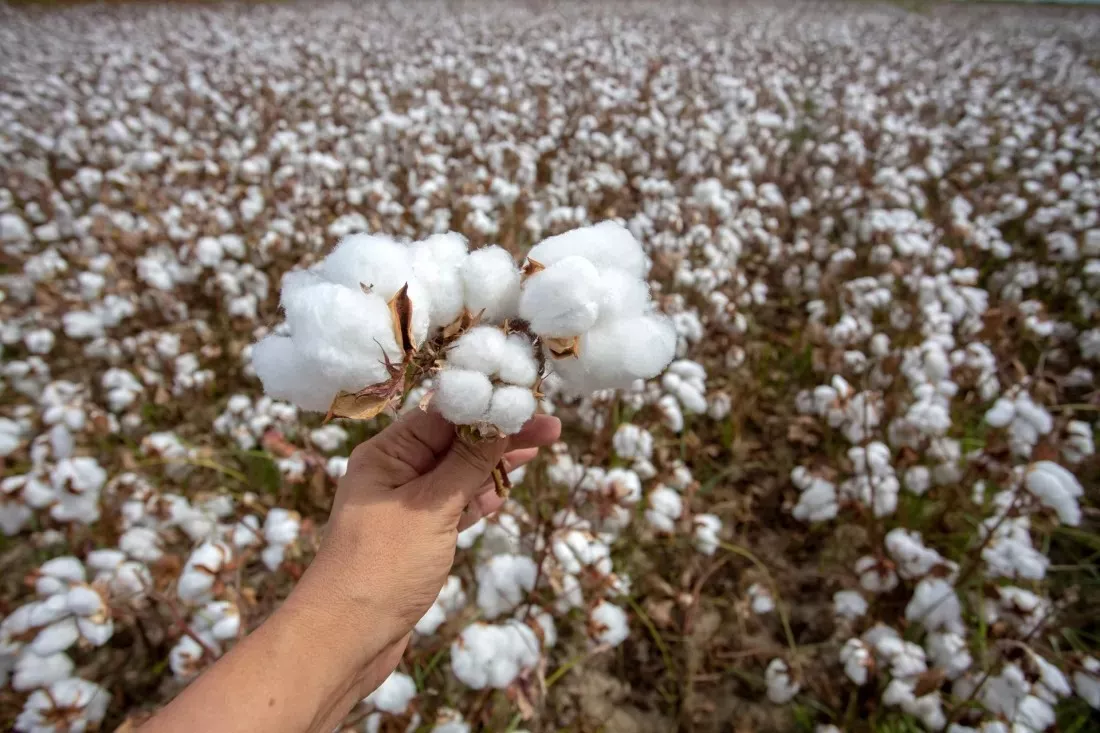
Dyeing fabric is one of the most environmentally damaging steps in making clothes: it uses huge amounts of water, and a lot of the dye never binds to the textile and stays in the water. A team led by Filipe Natalio at the NOVA University of Lisbon is taking a completely different route and wants cotton to take on its colour while the plant is still growing. The HYDROCOLTON project combines chemistry, plant biology and hydroponics – and at the end you can check how eco-friendly your wardrobe is.
Textile production still relies on practices established during the Industrial Revolution, and they are not suited to a sustainable long-term future. Two steps do the most damage to the environment: dyeing and finishing. This is where much of the water and chemicals go, yet a colourful T-shirt or hoodie gives no hint of how many resources it has consumed.
Filipe Natalio, associate professor at the NOVA University of Lisbon, points out that the problem is not only an ecological one. “Not only is this hard on the environment, but it’s also a very inefficient process,” the researcher says. As he explains, “Most of the water contains dyes that did not bind to the textiles.” In other words, a large share of the dye is simply wasted.
The scale of the problem is clear from the figures quoted in the article:
The last figure speaks especially to students, who often buy clothes quickly and cheaply. Every purchase leaves a carbon footprint, even if it is not printed on the label.
HYDROCOLTON, a pioneering textile sustainability initiative funded by the European Research Council, has set itself an ambitious goal: to make cotton plants produce coloured fibres as they grow. By changing how cotton absorbs, or expresses, pigments internally, the project aims at a complete phase-out of the water- and chemical-heavy processing that is now needed further down the production line.
Natalio knows how this sounds. “Sounds a bit like science fiction, I know,” he admits. And straight away he adds: “But we have shown the concept works.”
The traditional way to get coloured cotton in the growing plant would be genetics. The team chose a different path and harnessed the plant’s own biochemistry instead. The researchers put specially designed, glucose-derived molecules into the water. The plant transported them naturally, by capillarity, all the way to the developing cotton fibres, where the molecules became incorporated during growth.
The team calls this concept material farming. In Natalio’s words: “The idea is that, in the future, we could grow materials with built-in properties rather than manufacture and chemically process them afterwards.”
He compares it to a school classic: “It’s as natural as it gets. The analogy is the classic school experiment, in which a white flower is placed in dyed water to demonstrate water transport – but perhaps a little more advanced!”
For Natalio, one of the most exciting findings is that the approach worked in whole plants. At the same time, the team is open about how much remains to be explained. “We do not yet fully understand the underlying biological mechanisms, and answering those fundamental questions is exactly why this type of early-stage, curiosity-driven research is so important,” he notes.
Beyond the scientific discovery, the strategy has another advantage. Because it does not alter the plant’s genes, it could avoid many of the regulatory barriers and the problems with public acceptance that come with genetically modified crops.
HYDROCOLTON is testing the technology in real agricultural settings, using hydroponic cotton production, which provides a simplified and highly controlled system for trials.
The partner is Agromethod Labs, a women-led Portuguese start-up that is pioneering hydroponic cotton cultivation in the country. “They made Portugal the only European country, and one of the few in the world, to have the full cotton supply chain grown this way,” explains Natalio.
The ambitions reach beyond one country. “Our ambition is not simply to bring cotton production back to Europe, but to develop transformative practices here that can ultimately be adopted around the world,” he says.
It is early days, Natalio acknowledges. The team is working with collaborators to validate the technology and advance its market readiness. “These collaborations are helping us assess the technical and commercial potential, while engaging with relevant stakeholders across the cotton value chain,” he says. The next major step is to secure additional funding to scale up the technology and move it closer to market adoption.
For students of biotechnology, chemistry, environmental science or textile engineering, the project is a good example of how basic research meets a very practical problem of industry.
Dyeing fabric uses a lot of water and resources, and much of the dye never binds to the material. The Lisbon team has shown that glucose-derived molecules supplied to the plant with water can be built into growing cotton fibres. The method works in whole plants, does not require genetic modification and is being tested in hydroponic cultivation in Portugal. The biological mechanisms still await a full explanation and the road to market is still ahead.
5 questions · one minute


 EN

 CS
 DE
 ES
 FR
 HU
 IT
 PL
 PT
 РУ
 SK
 TR
 УК
 AR
 中文