
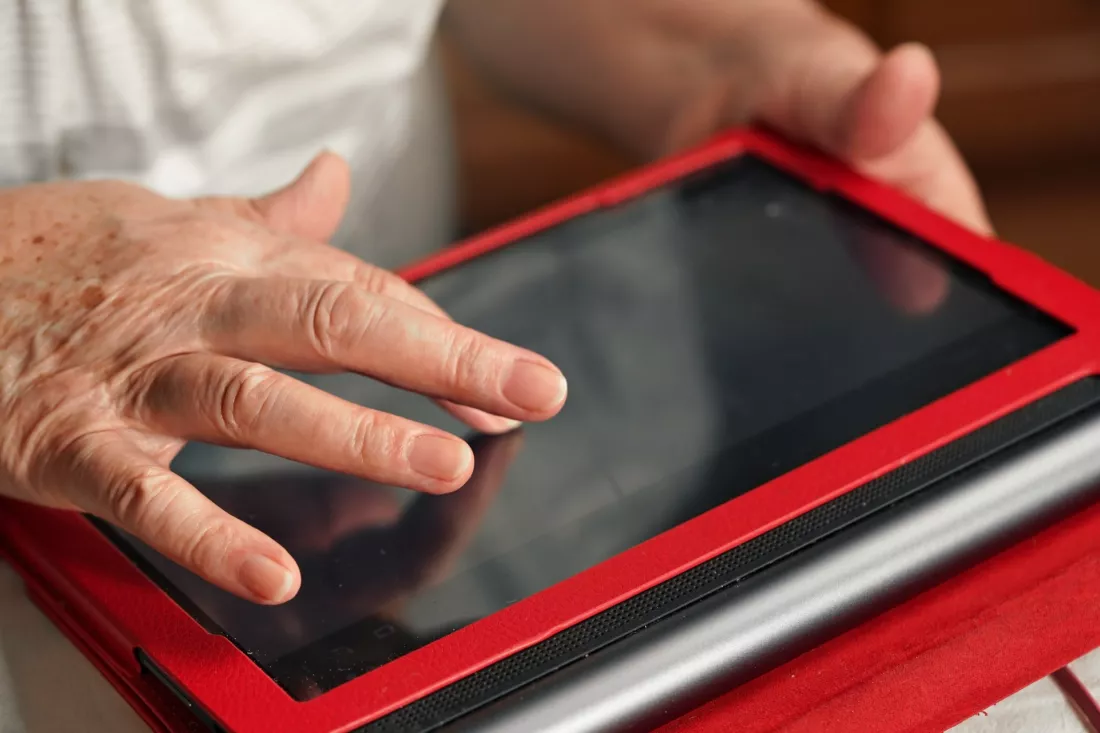
A smooth touchscreen is an everyday thing for most of us, but for blind and low-vision people it can be a wall without a single handle. A European team from the ABILITY project decided to change that: it built a tablet prototype that reproduces textures through vibrations and taught artificial intelligence to turn images into descriptions, sound or touch. See how it works and why the researchers began by talking to 285 users — and at the end you can check how accessible your own digital world is.
A touchscreen seems like the simplest thing under the sun: you swipe, you tap, done. But all that simplicity rests on sight and hearing. For blind and low-vision people, a smooth pane with not a single physical button can be a barrier rather than a help. The trouble affects even plain text, which still remains hard to access for this group.
Sabrina Panëels, a researcher on interactive systems at France’s CEA-List, puts it bluntly: “Considering our increasing reliance on technologies, dematerialisation and the use of buttonless touchscreens, a significant portion of the population is at risk of being denied access to content and becoming stigmatised even more because of their disabilities.”
Panëels leads the consortium of the EU-funded ABILITY project. The project ran from September 2022 to February 2026 and cost about €3.74 million. The researcher sums up its aim like this: “By using and developing new technologies and software and by leveraging haptic solutions, we aim to make digital content and devices more tangible for everyone.”
What is interesting is where the team began. Instead of shutting themselves in a lab, the researchers worked with 285 users, sighted and visually impaired, to learn their real needs.
The result is a prototype of a multisensory tablet. It has a 10.5-inch screen, runs on Windows and uses a standard OLED display enriched with additional haptic features. At the heart of the solution are vibrations. “The prototype uses localised and multitouch vibrations that can render textures depending on the underlying content, for both static and moving fingers,” Panëels explains.
The most ingenious part, though, is that every finger can feel something different. “It can also be felt independently by different fingers, meaning that when a user for example explores a map, one finger can feel the waves of the sea while another can feel the texture of forests and other topological elements,” the researcher adds.
The device was not the end of it. The team also developed strategies for designing content delivered by touch. The researchers tested how to combine a two-dimensional pin display with the multisensory tablet and with artificial intelligence that converts images, PDF files and graphs into content you can feel under your fingers in real time.
The second part of the project is software. The team built a set of machine learning algorithms tailored to the needs of people with visual impairments. They analyse an image and generate text, so the same digital content can be delivered in several ways:
What is the team proudest of? Panëels has no doubts: “We are particularly proud of our use of an image analysis pipeline and conversation AI solutions to deliver interactive descriptions of an image tailored to the individual user, as well as our predictive writing app that allows users to include emojis in their communications.”
Emojis in a project about accessibility? It sounds like a detail. But it is exactly such details that decide whether someone can write to friends as freely as everyone else.
The team showed that it is possible to build an affordable multisensory tablet supported by AI. In doing so it laid the groundwork for a commercial product and raised the bar for European technologies designed with the user and inclusion in mind. Panëels stresses that far wider groups can benefit: “Our work moves the needle on inclusive design and inclusion in general, benefiting not only the visually impaired, but also people with other disabilities, the elderly and even children.”
The tablet will not reach the shops just yet. More work is needed, and the researchers are now looking for funding and partners who will help develop the device and bring it to market.
Quite a lot, whatever your field. This story offers a few lessons that will be useful in any project of your own:
Designing an app, a website or just a presentation for class? It is worth asking yourself who is left on the other side of the glass.
The ABILITY project showed that a touchscreen does not have to be a wall for blind and low-vision people. Vibrations make it possible to feel textures under the fingers, and artificial intelligence turns images into descriptions, sound or touch. The prototype still needs work and partners, but the direction is clear: technology should be for everyone.
5 questions · one minute


 EN

 CS
 DE
 ES
 FR
 HU
 IT
 PL
 PT
 РУ
 SK
 TR
 УК
 AR
 中文