
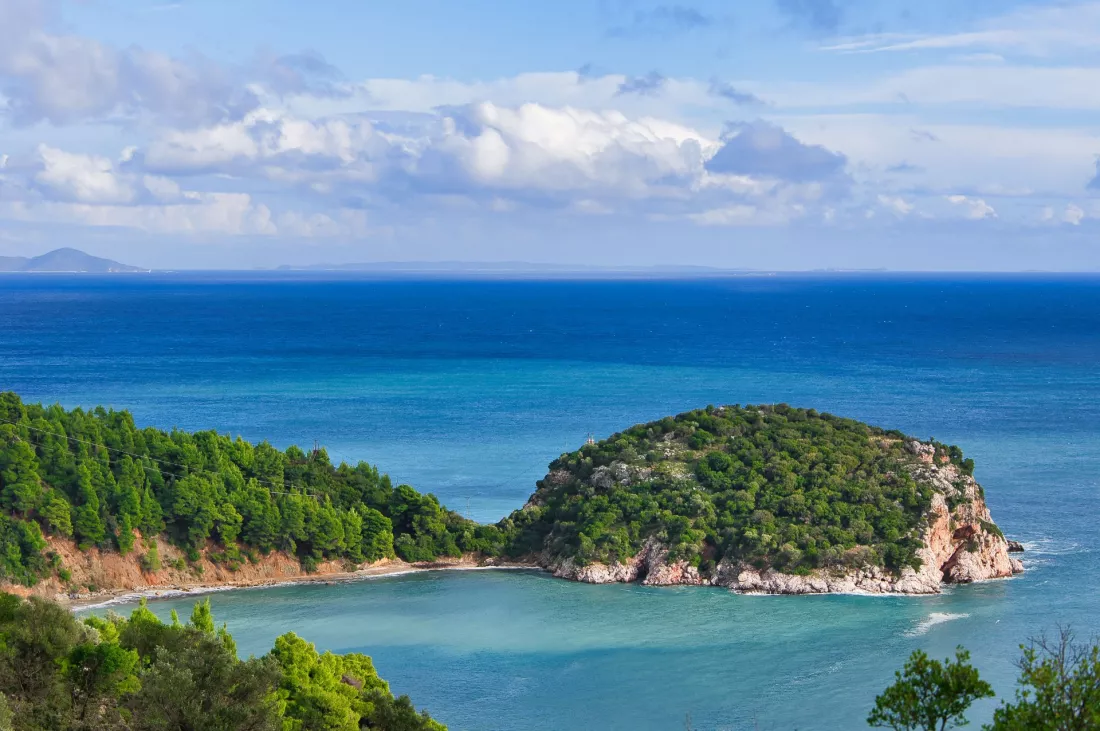
Abundance in winter, scarcity in summer: for generations this rhythm shaped life on Mediterranean islands. Now it is increasingly broken by violent downpours and sudden floods. On the Greek island of Skiathos, the NURISH project team wants to turn that problem into a resource: cleaning wastewater in solar-powered artificial wetlands and holding back rainwater in case of fires, drawing on local stone and old water paths — and at the end you can check how you treat water in everyday life.
For a long time, Mediterranean islands managed water according to a simple, repeating pattern. In winter there was plenty, in summer there was not enough, and residents knew what to expect and how to prepare. Climate change is now breaking that predictable cycle.
Droughts last longer and hit harder. Increasingly they are interrupted by rare but intense rainfall, followed by sudden flash floods. An island therefore receives water just when it is hardest to hold on to, and runs short just when it is needed most. Such a situation calls for a completely different way of thinking about infrastructure.
The search for answers is led by the team behind NURISH, a project funded by the European Union and coordinated by the National Technical University of Athens. The researchers want to redefine how island communities adapt to new conditions. Their testing ground is Skiathos, an island in the Aegean Sea that was recently named a key European resilience hub.
In this way Skiathos has joined a select network of climate resilience hubs that also includes locations in Cyprus, Finland and the United Kingdom. For the island it is a chance to combine valuable expertise with practical, scalable solutions, meaning ones that can later be repeated on a larger scale. The local consortium is currently planning specific actions.
The most important change concerns the very approach to water. The old model was to extract it and use it up. The interventions designed within NURISH are meant to shift islanders towards a model of regeneration and reuse, in which water circulates instead of disappearing after a single use.
The project also treats nature-based solutions as more than a piece of technical infrastructure. The team sees them as an expression of a necessary collaboration between people and their environment. That is an important distinction: the point is not only to build something, but to make sure that what is built works together with nature rather than against it.
The strategy for Skiathos rests on two pillars. The first is sustainable water reuse. Urban wastewater is to be treated in artificial wetlands combined with photovoltaic systems. This creates an energy self-sufficient loop: the water is cleaned and returned to the system, and the island can draw less on its local resources.
Constructed wetlands also differ from conventional infrastructure, which often sits apart from its surroundings. They are designed to blend into the island’s landscape and to shape it subtly, rather than dominate it.
The second pillar responds to a double threat: wildfires and floods. New systems will capture and store rainwater and flood runoff. The reserves collected this way will be used for firefighting and in agriculture. In practice, the solution combines several functions:
This is a significant change in crisis readiness. For the first time, natural systems for channelling and storing water are being designed with fire protection in mind, in a landscape increasingly exposed to wildfires. Streams stop being seen as a threat and become part of a wider support system. This strengthens the island’s resilience to climate-related risks and, at the same time, improves water availability when it is needed most.
The success of these systems, however, depends on their cultural grounding. That is why the project uses local stone, native plants and traditional water paths. As a result, the new infrastructure is meant to feel like a natural evolution of local knowledge, not technology imported from outside.
Such a link with the history of a place helps build community ownership. Infrastructure becomes a living system that needs care, but also gives it back. For students of engineering or landscape architecture this is an interesting lesson: a good technical solution does not end with calculations, but has to fit the place and the people who will use it.
The transition ahead is therefore not only technical. It is cultural as well. It prompts us to ask not just how we manage water, but what kind of relationship we build with it. The future of water on islands will not be shaped by nature alone, or by people alone. It will be decided in the space where the two meet and work together.
Skiathos is becoming a place where a new way of thinking about water on islands is being tested. The NURISH project combines wastewater treatment in photovoltaic-supported artificial wetlands with rainwater storage for firefighting and farming. The key turns out to be not only technology, but also respect for the local landscape, materials and traditions. Water that has so far been either a shortage or a threat is meant to become part of a shared, circulating system.
5 questions · one minute


 EN

 CS
 DE
 ES
 FR
 HU
 IT
 PL
 PT
 РУ
 SK
 TR
 УК
 AR
 中文