
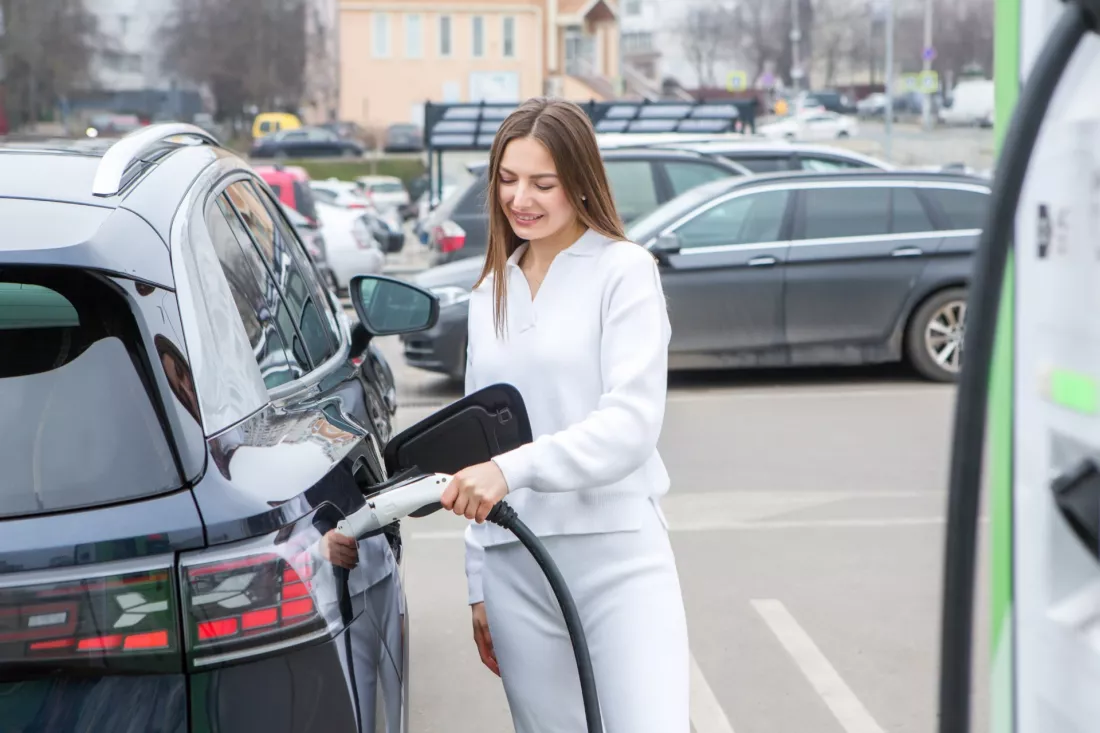
Limited range, long charging stops and too few charging points still keep many drivers away from electric cars. The European OPEVA project brought together 35 partners from nine countries to tackle these worries with artificial intelligence, energy-aware route planning for delivery vans and smarter battery management that watches every single cell – and at the end you can check whether you are ready to swap a petrol car for an electric one yourself.
Many people still hesitate to buy an electric vehicle. The reasons are familiar: the fear that the battery will run out before the next charger (the so-called range anxiety), charging times that are much longer than a visit to a petrol station, and a charging infrastructure that is still patchy in many places. For companies running delivery fleets the same issues translate directly into lost time and money.
The EU-funded OPEVA project set out to remove some of these barriers. Its goal was to make electric vehicles more reliable and more energy-efficient, both for individual drivers and for fleets, by combining better software with better battery hardware.
OPEVA, short for OPtimization of Electric Vehicle Autonomy, ran from January 2023 to the end of April 2026 and was supported under the EU research programme in the area of digital, industry and space. The consortium was coordinated by the French company Pertimm and brought together 35 partners from nine European countries.
According to Pertimm researcher Tom Dizdarevic, the key idea was to stop treating each problem separately. “Our work advances vehicle routing and battery engineering by moving beyond single-objective, isolated solutions and towards integrated, multi-objective and AI-driven systems that keep energy, safety and security at the centre of decision-making,” he explains.
A large part of the work focused on last-mile delivery, the final stretch of a parcel’s journey to the customer’s door. Ahmet Yazici, a professor at ESOGU, points out a weakness of existing software: “Traditional routing tools optimise a single objective and ignore the realities of EV operation – energy consumption, limited range and charging behaviour.”
To change that, the team developed KT9, an energy-aware routing service. Instead of looking only for the shortest or fastest route, it balances four objectives at the same time:
Behind the service is an adaptive large neighbourhood search algorithm combined with simulated annealing, a method inspired by the slow cooling of metals that helps the search avoid getting stuck in a merely “good enough” solution. The system also takes into account the characteristics of each vehicle and external factors. “Last-mile delivery is one of the most costly, congested and emission-intensive segments of the supply chain,” says Yazici. In his view, more energy-efficient routing reduces range anxiety, makes better use of fleets and cuts emissions exactly in cities, where they do the most harm.
The second pillar of OPEVA was the battery management system (BMS), the electronic “brain” that watches over the battery pack. The partners developed advanced algorithms for estimating the battery’s state of health and state of charge, fault-tolerant motor control, optical and wireless communication inside the vehicle, and cybersecurity features that protect these systems from attacks.
Dino Hrvanovic, a senior researcher at ViF, sums up the effect: “Together, these solutions improve EV battery performance, safety, reliability and user confidence while supporting sustainable mobility.”
One of the most technical results is a cell management unit (CMU) developed with the company Sensichips. It can carry out impedance spectroscopy – a measurement that reveals the internal condition of a battery cell – on individual cells while the battery is working, even in large industrial battery modules. “Our CMU introduces for the first time the capability to measure impedance spectroscopy at the individual cell level while the battery is in operation,” says Roberto Simmarino, president and CEO of Sensichips. The aim, he adds, is to use the battery to the full and give the driver dependable information about remaining life and range.
The project also produced federated and reinforcement learning models that predict battery health across a whole fleet, a 48 V smart BMS demonstrator, and passive wireless RFID sensors that monitor temperature and strain.
All these components were not left on paper. OPEVA validated them in nine real-world demonstrators, which allowed the partners to see how the algorithms and devices behave outside the laboratory. “Thanks to our unique collaborative approach, we turned research concepts into working, field-tested systems,” says Dizdarevic.
For many students the first car is still a few years away, but it may well be electric – and the parcels they order online are increasingly delivered by electric vans. Projects like OPEVA show that the fear of an empty battery is being addressed not only with more chargers, but also with smarter software and sensors. They also show where interesting careers lie: electromobility, computer science and artificial intelligence, control engineering and logistics all meet in this field. More details are available in the CORDIS article on the project.
OPEVA tackled the main worries of electric car drivers from two sides. On the road, the KT9 service plans delivery routes that balance distance, time, energy and punctuality. Inside the vehicle, new battery management algorithms, cell-level measurements and wireless sensors give a clearer picture of the battery’s health and range. Tested in nine demonstrators, these solutions bring more reliable and efficient electric mobility a step closer.
Source: CORDIS, European Commission.
5 questions · one minute


 EN
EN 
 CS
CS DE
DE ES
ES FR
FR HU
HU IT
IT PL
PL PT
PT РУ
РУ SK
SK TR
TR УК
УК AR
AR 中文
中文