
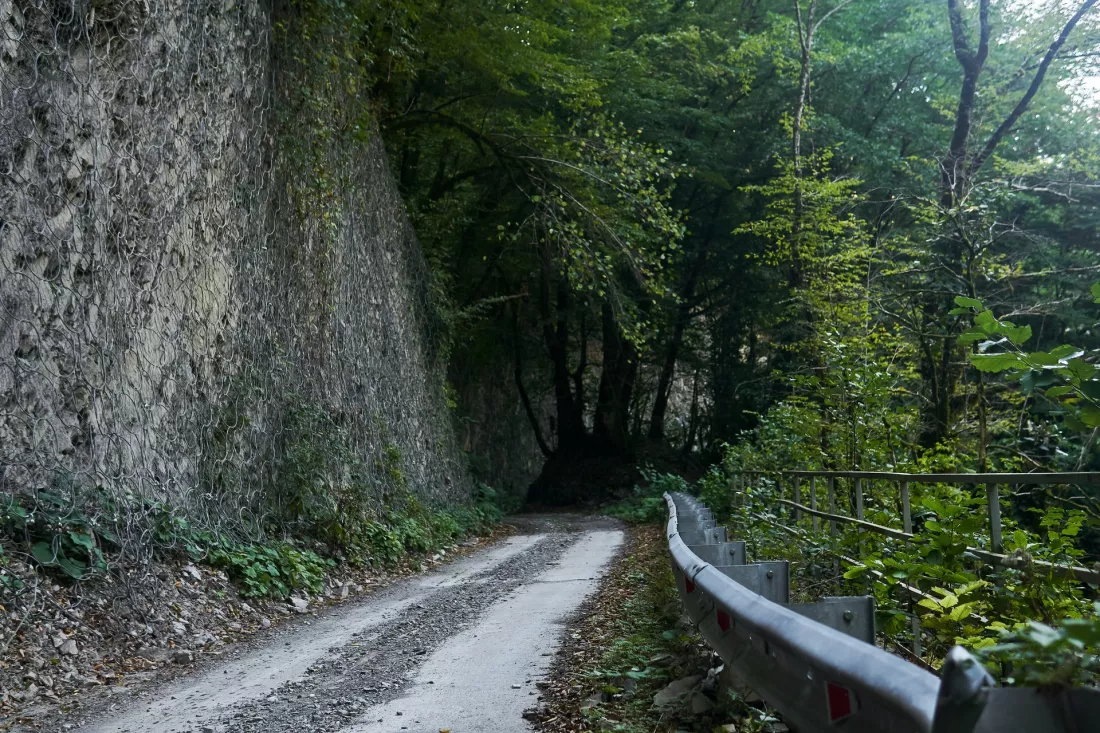
Rising temperatures, melting permafrost and violent storms are loosening mountain slopes, and a block breaking free above a road is no rare event. Engineers long modelled that block as one object on one path — yet it usually shatters in mid-air, becoming a spray of fragments with different reaches and different energies. A project run from Turin rebuilt the calculation around that fact, and the numbers it produces end up being decisions about money and people — and at the end you can check how you handle a risk estimate yourself.
Rockfall is one of those hazards that looks simple from a car window: something comes loose high up, it lands somewhere below. Warmer air, thawing permafrost and heavier rain are making slopes give way more often, and the ground underneath is rarely empty — mountain roads, railway lines, villages built where the valley is widest. Maddalena Marchelli of Politecnico di Torino in Italy sums up the range of what a single impact does: “A rockfall’s impact can cause fatalities and injuries, disrupt transportation networks, damage buildings and utilities and generate substantial financial losses.”
That one sentence is, in practice, a checklist that somebody has to put a price on:
Protecting against all of that costs money, and the money gets allocated on the basis of a calculation. If the calculation errs in a convenient direction, the barrier is built one size too small.
Most rockfall models treat the falling block as a single object that bounces, rolls and eventually stops. Reality is messier: the block hits the slope, cracks, and carries on as a dozen separate pieces. Marchelli states the consequence plainly: “When a falling rock breaks into multiple fragments, the resulting hazard can change dramatically, affecting the area exposed to impact and the potential damage caused.”
The reason is geometrical as much as physical. One trajectory becomes many, spreading sideways as well as downhill, so the strip of exposed ground widens. Each fragment carries less mass, but the fastest of them can travel further than the parent block would have. A fence sized for one heavy impact may instead face several lighter ones arriving together, in places the original model never marked.
The project that took this on is called RIDETHERISK. It ran at Politecnico di Torino under grant agreement 101103401, funded through the Marie Skłodowska-Curie Actions with an EU contribution of 238 938 EUR, from 1 November 2023 to 30 April 2026. What came out of it is a code named RockFRAG and a propagation model built on physical principles rather than on curves fitted after the fact.
The model takes in the quality of the rock mass and the shape of the blocks, is calibrated against experimental campaigns and then checked against real events that have already happened. That last step matters more than it sounds: a fragmentation model that only agrees with other models has not really been tested.
Classical practice picks a design event — a block of a plausible size, falling from a plausible place — and sizes the protection for it. RIDETHERISK works the other way round, combining the probability of each possible event with the damage it would do, across the whole set rather than a handful of chosen cases. Rare events do not drop out of the sum just because they are rare; they enter it weighted, which is the only way something that almost never happens but costs enormously can show up in a budget at all.
The methods were put to work in alpine transport corridors and in open-pit mines. The two settings ask different questions of the same tool. A corridor is about traffic that cannot be moved and a slope above it that cannot be removed. A mine is a workplace where the slopes are cut on purpose, people work beneath them every shift, and the geometry keeps changing as extraction goes on.
The work sits where engineering geology, mechanics and programming meet: you need to know why rock breaks the way it does, to describe the flight of a fragment, and to write code that runs the whole thing thousands of times over. None of those three is enough on its own, which is what makes the field hard to enter and comfortable to stay in.
The other half of the job is less technical. A risk figure ends up as a decision about spending, and Marchelli puts the point in terms of what better numbers buy: “Better risk assessments lead to better-informed decisions, more effective mitigation measures and a more efficient allocation of resources – all of which contribute to reducing risk and enhancing resilience.” Someone has to be able to say out loud what the numbers mean, to people who will never open the model.
A falling block rarely arrives in one piece, and for a long time the models pretended otherwise. RIDETHERISK put fragmentation into the calculation, with a code that follows the pieces and a risk framework that adds up every possible event instead of one convenient scenario. The estimates that come out are less comfortable and more honest — which, for a road running under a slope, is the difference that counts.
5 questions · one minute · nothing saved


 EN
EN 
 CS
CS DE
DE ES
ES FR
FR HU
HU IT
IT PL
PL PT
PT РУ
РУ SK
SK TR
TR УК
УК AR
AR 中文
中文