
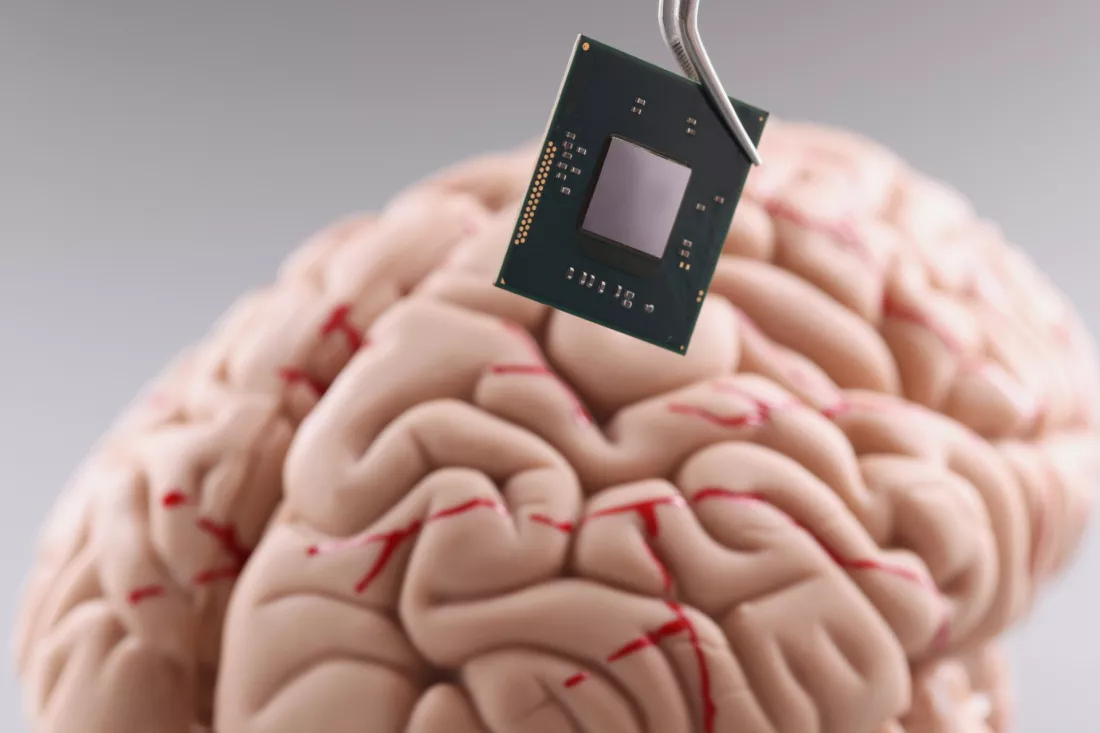
Brain–computer interfaces sound like pure science fiction, yet their biggest obstacle turns out to be ordinary physics: too much data, too little bandwidth and far too much heat inside the skull. A European team behind the IoN project has found a clever way around it, sending neural signals through body tissue instead of radio waves and transmitting only when neurons actually fire — and at the end you can check whether you have the kind of mind neurotechnology needs.
Every thought, movement and sensation leaves an electrical trace. To read those traces, researchers use high-density microelectrode arrays, or MEAs – tiny grids of sensors placed on the brain that pick up the activity of neurons across many points at once. The more channels such an array has, the sharper the picture of what the brain is doing.
There is a catch, though. A detailed picture means an enormous stream of information. In systems with 1 000 channels, the arrays produce more than 300 Mbps of data. That is the kind of flow you would expect from a decent home internet connection, except it has to leave a device sitting inside someone’s head.
Getting that data out of the skull is where things get tricky. Engineers designing brain implants keep running into the same set of limits, and they tend to pull in opposite directions:
Push harder on speed and you use more energy and generate more heat. Save energy and you lose bandwidth. Until now, this trade-off has been one of the main reasons high-resolution brain interfaces often relied on cables.
The EU-funded IoN project, whose name stands for Intranet of Neurons and which is coordinated by imec in the Netherlands, took a different route. Instead of using radio waves, the team relied on body channel communication, or BCC. The idea is simple to state and hard to pull off: the body’s own tissue becomes the medium that carries the signal.
In the IoN design, the data travels across the dura mater, the tough membrane that protects the brain. The microelectrode array floats freely beneath the dura, while a receiver unit is anchored in a small opening in the skull. There is no physical tether connecting the two, which means less strain on the surrounding tissue and a minimally invasive setup.
A clever concept still has to survive contact with reality. The researchers tested their link on human cadaver heads at Erasmus Medical Center, a setting much closer to real anatomy than a lab bench.
The results were striking. The system reached wireless transmission rates of up to 500 Mbps – comfortably above what a 1 000-channel array needs. It did so while running at a 20% duty cycle, meaning it was active only a fifth of the time to save energy. And it was remarkably accurate, with fewer than one error in every 100 000 bits transmitted.
Speed alone would not solve the heat and power problem, so the team added a second trick: smart compression. Neurons do not fire all the time, and much of the raw signal is quiet background. The IoN chip works a bit like a motion sensor for the brain, sending data only when neurons are active and staying idle the rest of the time.
This cuts the amount of data by more than ten times. Fewer bits to send means lower energy consumption and less heat, yet the recordings of action potentials – the electrical spikes neurons use to communicate – remain high quality.
Any device that sends signals through living tissue raises an obvious question: could it disturb the brain itself? To find out, the researchers ran tests on brain-on-a-chip models, small lab systems that mimic the behaviour of brain tissue. The verdict was reassuring: the communication link did not trigger unintended brain activity.
The IoN results are a step towards brain–computer interfaces that are scalable, energy-efficient and free of cables. Such interfaces are seen as a way to help people living with neurological disorders in the future, although the work described here is about the underlying technology rather than a ready treatment.
It is also a good example of how modern neuroscience works. Solving the problem required knowledge of anatomy and medicine, chip design and electronics, as well as signal processing and computing. Fields such as biomedical engineering, electronics and neuroinformatics meet right here, and projects like IoN show how much can happen at that crossroads.
High-density brain implants generate far more data than traditional wireless links can handle without draining power or overheating. The IoN team tackled this by sending signals through tissue across the dura and by transmitting only when neurons fire. Tests on cadaver heads showed speeds of up to 500 Mbps with very few errors, compression cut data more than tenfold, and lab models suggested the system does not disturb brain activity.
5 questions · one minute


 EN
EN 
 CS
CS DE
DE ES
ES FR
FR HU
HU IT
IT PL
PL PT
PT РУ
РУ SK
SK TR
TR УК
УК AR
AR 中文
中文