
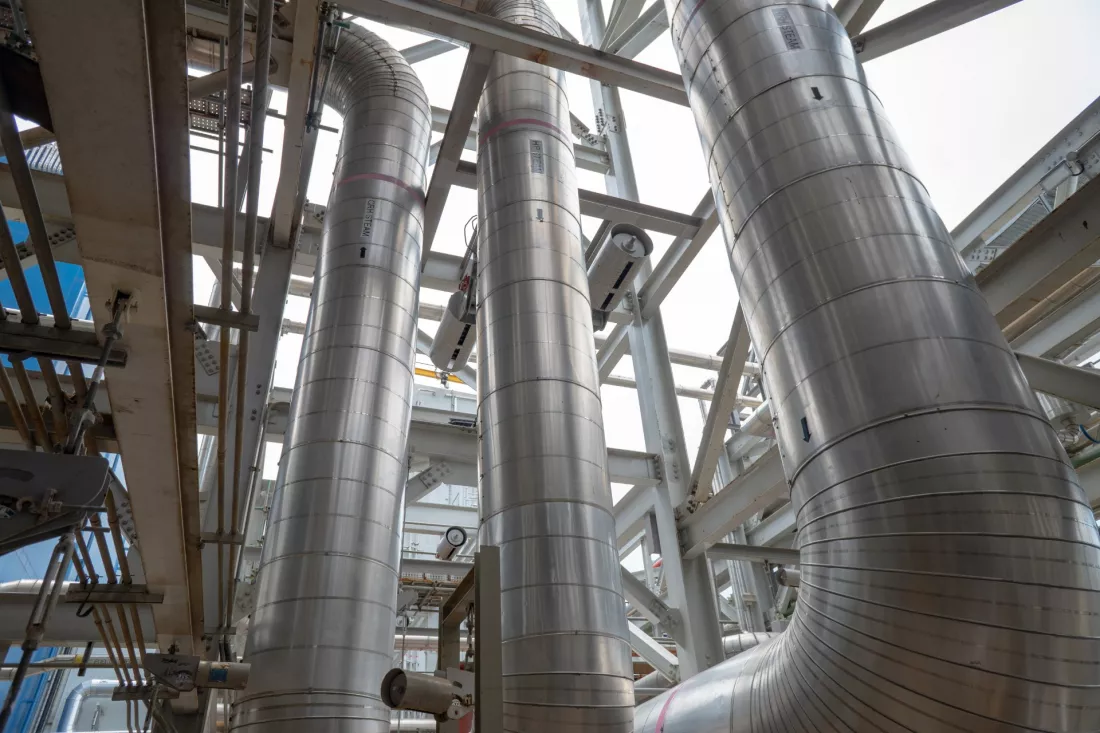
Around 70 percent of the energy we produce escapes straight into the atmosphere as heat. The hardest to put to use is lukewarm heat below 100°C, because recovering it usually does not pay off. The Swedish company ZIGRID says it has a way to do it, and without any turbine: a gas that rhythmically expands and contracts and, in the end, turns a generator. See how it works and where the technology is headed, and then check how much of this energy puzzle stayed in your head.
Europe wants to reach net-zero emissions by 2050. The direction seems clear: fewer fossil fuels, more sun and wind. Coal production keeps declining, while solar and wind power take an ever more important place in the energy mix.
There is, however, a problem that gets mentioned less often than panels and wind turbines. Around 70% of the energy produced is wasted as heat that simply ends up in the atmosphere. This is not an abstract loss: it affects the carbon footprint and the costs of energy-intensive industries, and it also warms the surroundings.
Plants can recover waste heat, but it does not always make economic sense. When the heat is of low quality, meaning below 100°C, such solutions usually do not pay off.
The result? Energy that has already been produced is lost to no purpose.
The Swedish company ZIGRID took on this problem. The project is called ZiGrid Technology, and its English title captures the ambition well: Shifting Waste Heat from Problem to Power, or roughly, moving waste heat from the category of problem to the category of power.
Where does the topic come from? Lars Birging, the project coordinator, points to the team's own experience: “One of our founders had a deep understanding of the issue of residual heat from manufacturing industries.” Further research and visits to other industries showed that waste heat was a serious problem, not a curiosity of a single sector.
The principle can be explained without formulas. The technology takes residual heat at 50–80°C and uses it to heat and expand a gas. The material cyclically expands and shrinks, a bit like lungs that keep drawing in and letting out air.
“The power of this cyclical movement is harnessed through hydraulics, which drives a generator to create electricity,” explains Birging.
The most interesting part is what this system does not have. “What makes this technology unique is that it does not use turbines,” the coordinator stresses. According to its creators, this is exactly why the device keeps higher efficiency at low temperatures and can operate from as little as 50°C.
It is worth putting together the numbers that appear in this story:
The project received support from the European Innovation Council (EIC). The aim was to prepare the technology for the market, and along the way the company analysed where it could sell it. The total cost of the project was EUR 4 147 365, of which the EU contribution was EUR 2 499 999. The work ran from 1 March 2024 to 31 August 2026.
“The idea was to take us from conducting tests at customer sites to optimising and quality-assuring our product,” says Birging. To make that happen, a technical team was set up to deal with scale-up problems.
Configurations of different sizes were tested in the steel industry. The results were compared with those of hydrogen producers and of the paper and pulp industries.
Not everything went smoothly. “At one of our pilot sites, we were forced to address more challenging temperatures than we had expected, but this helped with our development,” admits Birging. The team pointed out the key areas to refine and turned the results into a technical work plan aligned with the business plan.
Where could this technology be most useful? The team points to data centres, which generate large amounts of heat. “These fit our solution very well, and have become our most strategic segment,” says Birging. The company considers this segment the most important strategically.
The next steps are certification, scaling up production capacity and signing agreements with customers, who include hydrogen producers and data centres. The whole effort is meant to support the EU's energy and climate goals.
This story shows that the energy transition is not only about new wind farms and roofs full of panels. Just as important is the question of what to do with energy that has already been produced and is escaping right now. For students of energy engineering, mechanical engineering or environmental engineering, it is a good example of how simple physics, a gas that expands and contracts, can turn into a product with a business plan, tests at a steelworks and a list of customers. And for future computer scientists there is a curiosity: the heat from a server room, a nuisance today, is a raw material for this company.
In the ZiGrid Technology project, the Swedish company ZIGRID is developing a system that turns waste heat at 50–80°C into electricity, with no turbines, thanks to a cyclically expanding and shrinking gas and a hydraulic system. The technology was tested in the steel industry, and the company is now aiming at certification, higher production and customers such as data centres and hydrogen producers.
5 questions · one minute


 EN

 CS
 DE
 ES
 FR
 HU
 IT
 PL
 PT
 РУ
 SK
 TR
 УК
 AR
 中文