
When the first farmers appeared in the Eastern Baltic, dairy products arrived with them, yet people kept eating a lot of fish. These are the findings of the European PaleoMIX project at the University of Tartu in Estonia, which used biomolecular archaeology to study the transition from foraging to farming. See how researchers read the past from pots and bones, and at the end take a short test to check how much you remember.
The first farmers in the Eastern Baltic still ate substantial amounts of fish, and dairy products reached the region together with the first farming communities. These are the key findings of PaleoMIX, a project funded by the European Union and carried out at the University of Tartu in Estonia. The team studied neolithisation, the transition from foraging to farming, which transformed how people lived and how societies were organised.
PaleoMIX also had a second goal. Biomolecular archaeology has long developed mainly in a small number of large laboratories in western Europe. The team at the University of Tartu wanted to reduce this imbalance and show that top-level research can also be done in the Baltic region, close to the places where the studied finds come from.
Biomolecular archaeology studies molecules preserved in artefacts and remains: DNA, proteins, fats (lipids) and isotopes of chemical elements. With their help, researchers can work out what people ate, which animals they kept and how they lived, even when only a small fragment of a vessel survives. It is a field at the meeting point of archaeology, chemistry and biology, and it needs well-equipped laboratories and specialists from several disciplines.
The University of Tartu had a lot to build on. It already had an ancient DNA laboratory, a new archaeochemistry laboratory had been set up, and the university has a group of international researchers as well as scholars who returned from exchanges abroad with new expertise. PaleoMIX grew out of a research idea that had earlier gone unfunded under the Marie Skłodowska-Curie actions, and it relied on partnerships with the University of Copenhagen, the University of Burgos and the University of York.
“We demonstrated that cutting-edge biomolecular archaeology can thrive beyond the traditional centres of excellence, inspiring others to build similar capacities in regions where such research was previously out of reach,” notes project coordinator Mari Tõrv. The example of the University of Tartu is therefore meant to encourage researchers in other regions to build similar capacity at home.
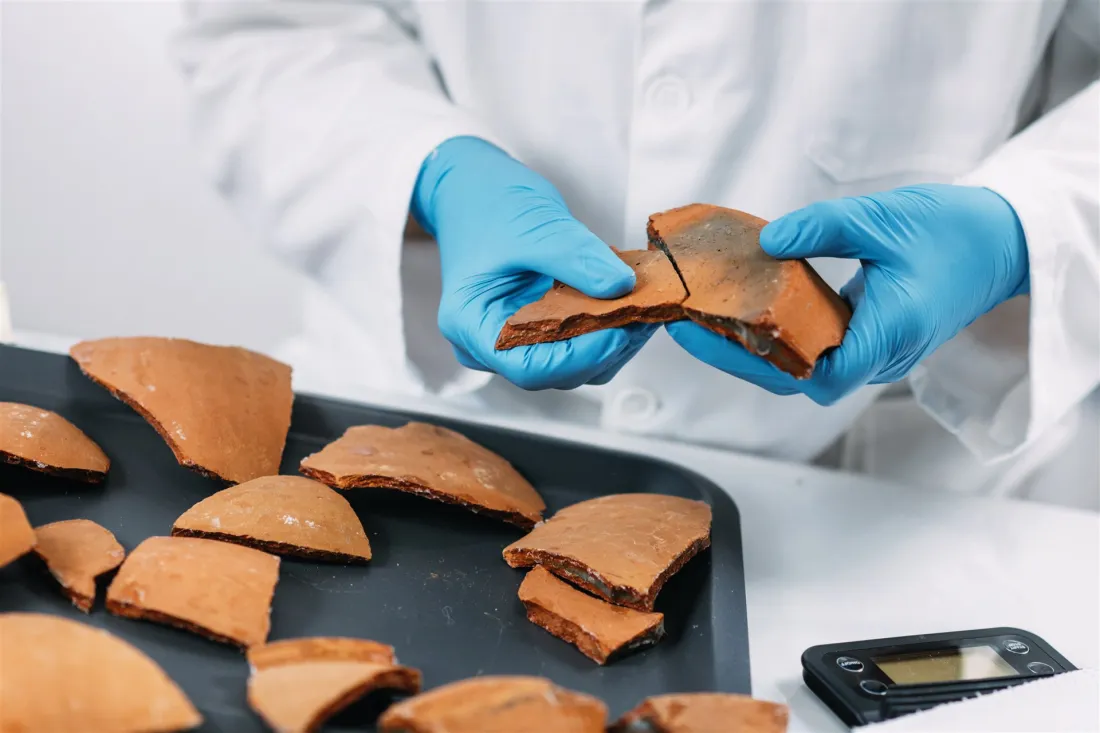
PaleoMIX researchers examined pottery and human remains from the Eastern Baltic. “Lipid analyses of pottery proved that dairy products arrived in the region alongside early farming populations. Proteomic analyses identified the exact animal species whose dairy products were processed in those pottery vessels,” explains Tõrv. Traces of fat preserved in the walls of pots thus turned out to be a record of what was cooked thousands of years ago.
Isotope analysis of human remains showed that the transition to farming was not straightforward. The first farmers still consumed substantial amounts of fish, so they did not abandon their old way of obtaining food right away. This finding was not visible in isotope analyses of bulk samples. Only more precise methods made it possible to see that farming and fishing existed side by side for some time.
The PaleoMIX team combined several methods, including the SPIN technique. Together they refined the chronology of the transition to farming and provided new insights into how farming spread across northern Europe:
Stable isotopes are variants of elements such as carbon or nitrogen that do not decay over time. Their proportions in the body depend on what a person ate. This makes it possible to tell apart someone who lived mainly on fish from someone who ate mostly grain and meat from farm animals.
The PaleoMIX team also wanted the University of Tartu to become a recognised centre of biomolecular archaeology in the Baltic region. Staff training, knowledge exchange and new equipment helped, as did community engagement and ethical leadership. International visibility grew in 2023, when the team organised the 10th meeting of the International Society for Biomolecular Archaeology. It brought together more than 400 researchers from around the world.
The lasting legacy of PaleoMIX includes the open online course “Unlocking the Past: Basics of Biomolecular Archaeology” for students and professionals. Researchers also established a code of conduct for invasive biomolecular sampling. The code is meant to underpin sustainable and responsible research practices, because every sample taken from an artefact means partly destroying it.
Fun fact: the name ZooMS is short for “Zooarchaeology by Mass Spectrometry”. The method identifies an animal species from the collagen protein, so even a tiny bone fragment that cannot be recognised with the naked eye is enough.
“We made vital contributions to preserving European cultural heritage by enabling archaeological collections from the Baltic region to be analysed and interpreted within the communities and countries they originated in,” states Tõrv. Research carried out on the spot supports local stewardship of cultural heritage and helps people make informed decisions about how to protect it. New evidence from the Eastern Baltic has also entered the wider discussion of European prehistory.
PaleoMIX researchers showed that Europe’s shared heritage is built upon a rich diversity of regional experiences and cultural traditions. The core activities are complete, but research publications are still being released. Efforts are also ongoing to set up a joint master’s programme in biomolecular archaeology, which the University of Tartu is preparing together with all the project partners.
PaleoMIX shows that archaeology today also means work in the laboratory and at the computer. Knowledge from several degree programmes comes in handy in such research:
The PaleoMIX project at the University of Tartu in Estonia used biomolecular archaeology to study the transition from foraging to farming in the Eastern Baltic. It turned out that dairy products appeared there together with the first farmers, while people kept eating a lot of fish. The project left behind an open online course and a code of conduct for sampling, and its partners are working on a joint master’s programme.
5 questions · one minute


 EN

 CS
 DE
 ES
 FR
 HU
 IT
 PL
 PT
 РУ
 SK
 TR
 УК
 AR
 中文