
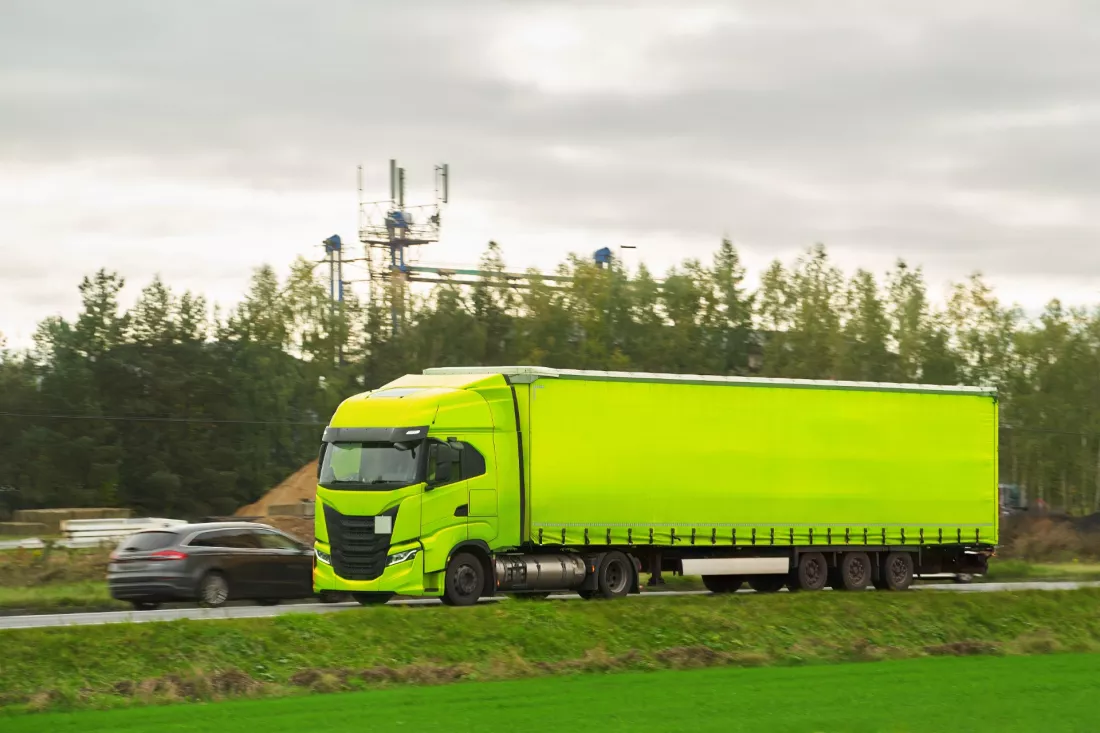
Heavy-duty vehicles account for nearly 40% of CO₂ emissions from road transport in Europe, and switching them to electric power is much harder than with an ordinary passenger car. Researchers from the EU-funded RHODaS project looked where people usually do not – at the electronics that distribute energy between the battery and the motor. They bet on new semiconductors, a modular design and tests all the way up to full scale – and at the end you can check whether you have a head for electromobility.
Electric cars on the streets no longer surprise anyone. Trucks are a different story. Heavy-duty vehicles account for nearly 40% of road-related CO₂ emissions in Europe, and electrifying them runs into considerable technological constraints. In short: the bigger the vehicle and the longer the route, the harder it gets.
This is exactly what the EU-funded RHODaS project dealt with, coordinated by the Polytechnic University of Catalonia (UPC) in Spain. The work ran from May 2022 until the end of January 2026.
When we think of an electric car, we usually picture the battery and the motor. Yet between them works something few people have heard of: power electronic converters. They manage the flow of energy from the battery to the electric motor. David Lumbreras of UPC calls them, quite plainly, the critical interface of the whole system.
Until now such systems have been built on silicon-based semiconductors. Silicon, however, has its limits.
Help comes from wide-bandgap semiconductors. They can operate at switching frequencies above 100 kHz while producing significantly lower losses than silicon. In practice this means converters with high power density – exactly what long-haul transport needs.
The RHODaS team bet on a duo of two materials, and each was given a different role:
Combining the two delivered higher efficiency, a smaller system volume and less electromagnetic interference.
The project’s central achievement is an integrated motor drive. In a single compact, modular housing it brings together three things: power electronics, thermal management and digital control.
Modularity is no mere decoration here. Such a design is easier to repair, more tolerant of faults, and the same basic design can be scaled to different power levels. Instead of designing everything from scratch for each vehicle, modules can be chosen to fit the need.
The ideas were validated in three steps. First at the material level: devices and drivers were examined for stress, functional integrity and immunity to electromagnetic noise. Then a laboratory-scale converter was tested. Finally came full scale – a full-size integrated motor drive, coupled with a gearbox, went onto a test bench.
“We successfully met our technical milestones,” sums up David Lumbreras.
Not everything went smoothly. The biggest lesson turned out to be the instability of early pre-series gallium nitride transistors. To make the system work stably, the hardware had to be thoroughly redesigned.
That is good news for anyone just starting out in engineering. Even in a large European project a new component can come as a surprise, and the response is not to abandon the idea but to fix the design.
The consortium already has plans for the next steps. The modular drive is to be scaled up to a wider range of vehicle classes, and the results integrated into the plans of industrial partners such as Valeo Siemens.
Things get interesting with business models. The team wants to develop circular-economy solutions, for example ‘product-as-a-service’ or leasing. On top of that come digital vehicle passports (DVPs) – secure, cloud-based records of a vehicle’s entire life cycle. They are meant to make servicing at the level of individual components and the reuse of parts easier.
RHODaS also supported building an innovation network that links universities with industry. Its job is to help put the project’s results to use and keep supplying the sector with cutting-edge technologies. For students of technical subjects this is a signal that power electronics does not stay inside the laboratory – it leads straight to factories and onto the roads.
Lumbreras hopes the project will have a lasting impact: contributing to the goals of the EU Green Deal and to better air quality. He also points out that a solid European supply chain for power electronics will reduce dependence on manufacturers from outside the EU.
An electric truck is not just a bigger battery. The key is electronics that pass energy to the motor efficiently. The RHODaS project combined silicon carbide and gallium nitride in a modular drive, tested it up to full scale and drew lessons from the transistor problems. Now the solution is meant to reach further vehicle classes.
5 questions · one minute


 EN

 CS
 DE
 ES
 FR
 HU
 IT
 PL
 PT
 РУ
 SK
 TR
 УК
 AR
 中文