
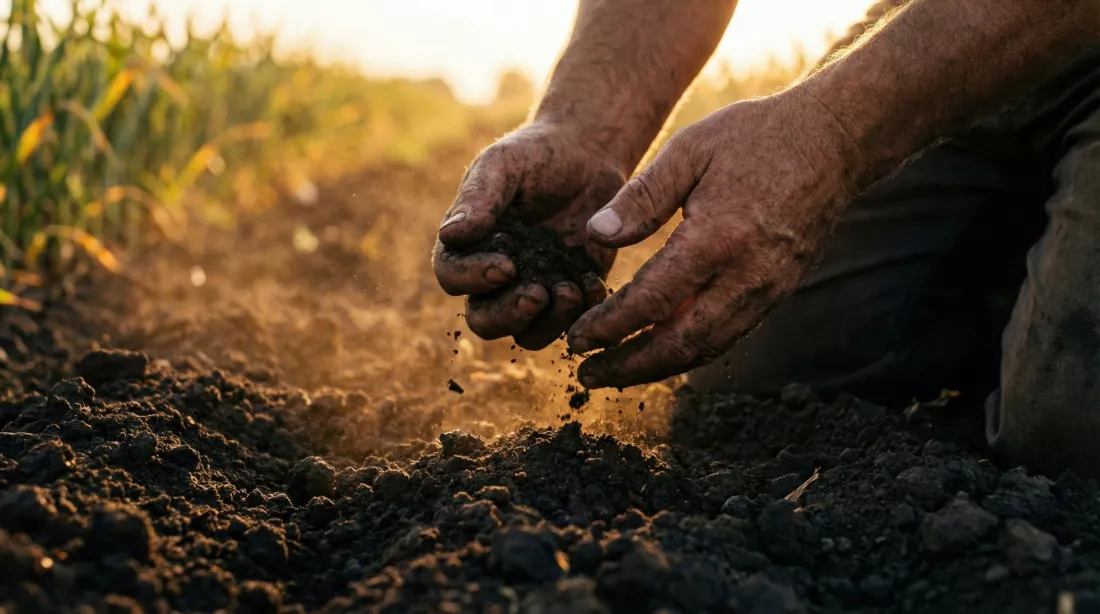
A museum that shows soil pH and moisture live, a travelling art exhibition with a stop in Poland, and booklets with audiobooks for policymakers. The European project SoilTribes is trying to convince us that what lies under our feet deserves more attention. It combines science, technology and art, and the curator argues that soil lives with us. We look at how it works and what it can teach a student — and at the end you can check how closely you look at what is beneath your feet.
Soil rarely makes the front page. It lies under our feet, under the pavement, under the lawn in front of the faculty building, and hardly anyone thinks about it. The EU-funded SoilTribes project decided to change that. Its goal is easy to describe but harder to achieve: to raise public awareness of the role soil plays and of the threats it faces.
The most interesting part is how the authors want to get there. Instead of a single report or a poster campaign, they bet on combining three worlds: science, technology and art.
SoilTribes began in 2025 and brings together 25 partners from 11 European countries. Since the start of its activities it has set up three undertakings that at first glance have little in common:
Each of them reaches a different audience. Together they form a puzzle in which soil is sometimes an object of research, sometimes a source of inspiration, and sometimes a matter for the authorities to deal with.
The first Living Soil Museum was established in Ukraine. Its eastern hub was inaugurated in June 2026 at the Poltava State Agrarian University. The museum is part of the initiative Soil Ark: Shaping Soil Futures Together.
This is not a place with display cases full of dusty samples. The museum monitors soil pH, temperature and moisture in real time, so visitors deal with data that changes before their eyes. They can also learn about the soil ecosystem and the role microorganisms play in it.
The museum’s location says a lot. Since it operates at a university, it brings research and education together literally under one roof. For students of the natural sciences, agriculture or environmental studies, it is a good example of how knowledge from the laboratory can reach beyond a narrow circle of specialists. And of how it can become an attraction for anyone curious about what is going on a few centimetres beneath their boots.
The second leg of the project is culture. SoilTribes partner Global Network of Water Museums has prepared a travelling exhibition, Soil Art Tales. Living Ecosystems for Shared Futures. It explores the connections between soil, water and life, and it brings together works by four artists from different generations.
The exhibition is to be hosted by seven institutions in six countries: Bulgaria, France, Italy, Poland, Portugal and Slovenia. Poland is therefore on this map, which gives you a chance to see it without travelling far.
The curator is Stefano Cagol. In his view, through empathy, their own perspectives and the transcoding of their works, the artists show that soil has a shared, fundamental value. Cagol points out that soil holds memory, carries the traces of past civilisations and nourishes every future we can imagine.
He also argues that turning scientific knowledge into narratives that engage the senses and offer shared experiences helps build awareness, care and responsibility. He puts it most briefly like this: “Soil is alive—and lives with us.” And he adds: “Recognising its vitality means acknowledging our interdependence with the ecosystems that sustain us.”
About the task of the exhibition, the curator is direct: “Our challenge is to make these precious tales known across Europe and beyond.”
The third element is the least spectacular, but it may have real effects. It is Policy Pathways, a resource for people who make decisions on public matters. It will include a series of five digital booklets and audiobooks, prepared by project partner ICLEI Europe.
Each booklet deals with a different soil challenge and describes what public authorities can do. The first is devoted to preventing and reversing soil sealing. More booklets are to be published progressively.
In SoilTribes the same problem is told in three ways. A scientist will see in it measurements of pH and moisture. An art lover, a story about memory and culture. An official, concrete paths for action.
For a student this is a valuable lesson: even highly specialised knowledge gains when someone can translate it into the language of other people.
SoilTribes combines a museum that tracks the state of soil in real time, a travelling art exhibition and a base of materials for decision-makers. The project is meant to contribute to the long-term sustainability of soil, and its work will continue until December 2027. Until then, it is worth keeping an eye on the Soil Art Tales exhibition, which is also due to come to Poland.
5 questions · one minute


 EN

 CS
 DE
 ES
 FR
 HU
 IT
 PL
 PT
 РУ
 SK
 TR
 УК
 AR
 中文