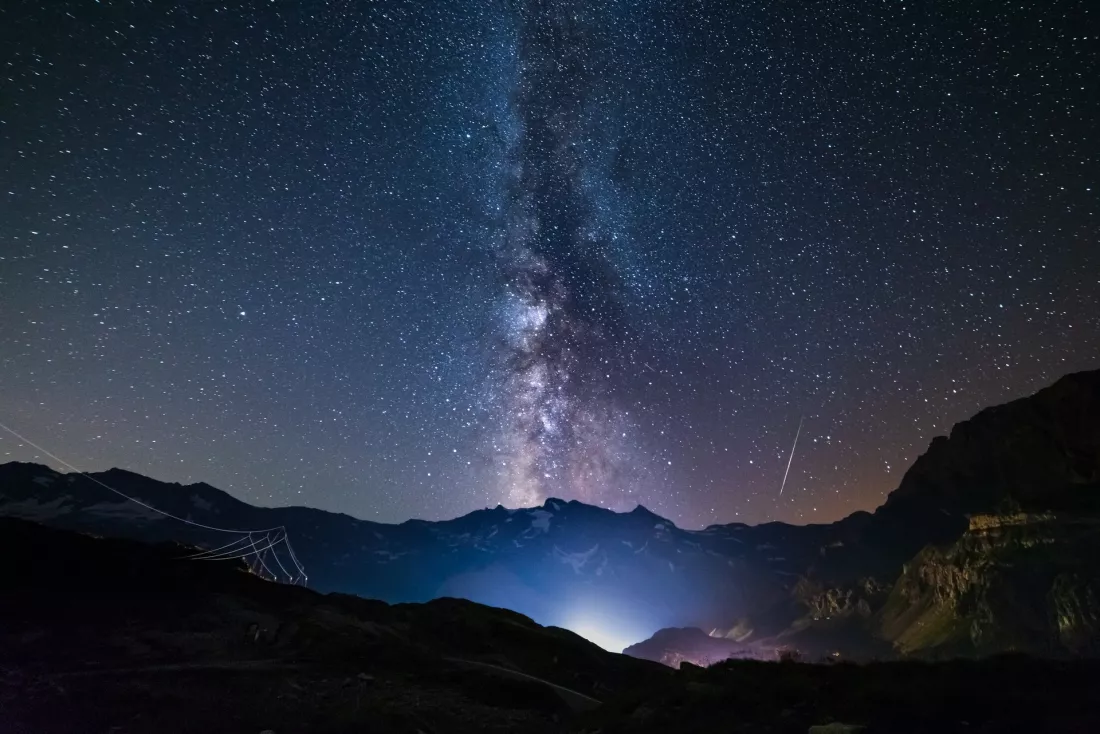
Lie on a blanket somewhere far from the city and one thing becomes obvious within a minute: the stars are not scattered evenly. Some patches of sky are crowded, others look almost empty, and a pale band runs straight across the middle. The answer to that one naive question leads through gravity, the shape of the Milky Way, three families of galaxies and a collision already pencilled in for ten billion years from now – and at the end you can check what kind of sky-watcher you are.
Go far enough from the city on a clear night and the sky stops being a flat backdrop. Some parts of it are crowded with points of light, others look almost empty, and a faint band stretches from one horizon to the other. The obvious question – why are the stars not spread out evenly? – sounds naive, and it is exactly the kind of question professional astronomers spend their careers on.
Reinout van Weeren, associate professor at Leiden University, puts the starting point plainly. “There is structure, in the sense that the distribution of stars is not completely random, but to make something completely uniform would be very special,” he says. Perfect evenness would be the strange result, not the clumpiness.
The short answer is gravity. Matter attracts matter, so a region slightly denser than its surroundings only grows denser, gathering gas and stars into clusters and whole galaxies. What is left between those concentrations is emptiness, and as the universe expanded the galaxies drifted further apart, leaving enormous voids in between.
Van Weeren reaches for a comparison closer to home. “A forest also contains many different types of trees of all sizes,” he says. “The same goes for the night sky.” Nobody expects a wood to grow in a grid, and nothing in the physics of the universe asks for one either.
The second half of the answer has nothing to do with the universe and everything to do with the observer. The Milky Way holds roughly 100 billion stars, and the Sun sits out on its outskirts rather than anywhere near the middle. From that seat, the view depends entirely on which way you turn your head.
Look away from the galactic centre and the line of sight passes through a thin layer of stars into open space. Look towards it and the same line crosses the full depth of the disc. “If we peer towards the centre, we can even see a band of billions of stars overlapping,” van Weeren says. That band is the Milky Way as people have seen it for as long as there have been people.
Galaxies themselves are not all alike, and the differences say something about their past:
Shape, in other words, works as a kind of biography. A galaxy left alone tends to keep its structure; one that has been through a merger usually does not.
The Milky Way will not be left alone. In about 10 billion years it is expected to collide with the Andromeda Galaxy, and the result is not the slow-motion catastrophe the word suggests. Stars sit so far apart that they hardly ever meet; what really collides is the gas.
That first produces a burst of star formation on a scale the galaxy has not seen in a very long time. Then comes the quiet part: once all the gas has been used up, there is nothing left to build new stars from.
Zoom out further and galaxies gather into clusters, where the population changes character. “It turns out that galaxy clusters are almost exclusively comprised of elliptical galaxies,” van Weeren says. The spirals, somehow, do not survive the move.
Finding out why was the job of ClusterWeb, a project he led with funding from the European Research Council (ERC) under the identifier 804208. The suspect is the hot gas filling the space between cluster galaxies: it appears to strip an arriving galaxy of its own gas supply, and a galaxy without gas stops making stars. The mechanism is still being investigated, and an answer would say a great deal about how galaxies evolve.
None of this looks much like the postcard version of astronomy. There is no lone figure at an eyepiece. There is physics, there are very large data sets to be processed, and there is the patience to work on a question whose answer will not arrive this term.
That is worth knowing before choosing a degree. The field rewards people who enjoy the processing as much as the picture – and it still starts, reliably, with somebody lying on a blanket and asking why the sky looks the way it does.
Stars are spread unevenly for two reasons at once. Gravity gathers matter into galaxies and leaves voids between them, and our own position on the edge of the Milky Way decides how much of that structure falls into any given line of sight. Galaxies come in spiral, elliptical and irregular forms, they merge, and in clusters almost only the ellipticals remain – which is exactly what projects like ClusterWeb are trying to explain.
5 questions · one minute · nothing saved


 EN
EN 
 CS
CS DE
DE ES
ES FR
FR HU
HU IT
IT PL
PL PT
PT РУ
РУ SK
SK TR
TR УК
УК AR
AR 中文
中文