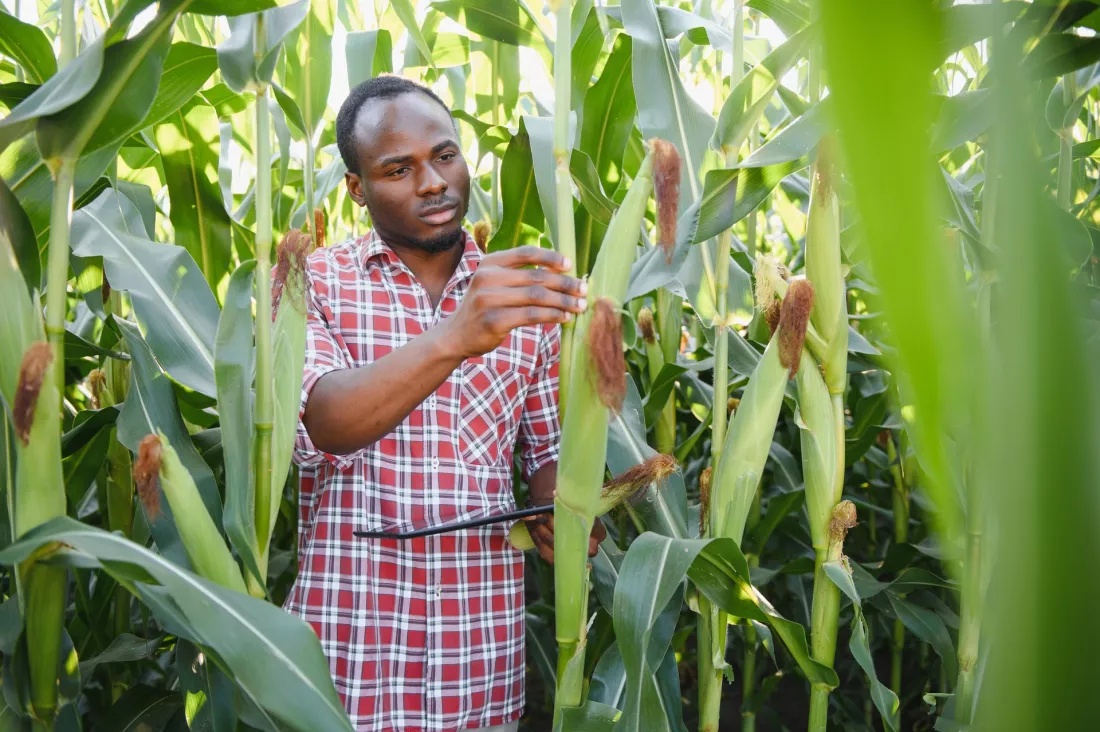
Planning what millions of people will eat twenty-five years from now sounds like a job for science fiction, yet a Horizon Europe project spent three and a half years doing exactly that. FoSTA-Health studied Malawi, South Africa, Tanzania and Zambia and found that a food system is far more than farming: it is soil, animal health, human health, trade and policy tangled into one knot. The team sketched four possible routes to 2050 – and at the end you can check whether you think in systems or in separate cases.
Ask most people where food comes from and the answer stops at the farm. A food system begins much earlier and ends much later: with the state of the soil, the health of the animals grazing on it, the roads and markets that move a harvest, the prices households can afford and the rules that decide what may be sold and where. Move one of those pieces and the rest move too, sometimes in a direction nobody planned.
That is the starting point of FoSTA-Health, short for Food Systems Transformation in Southern Africa for One Health, a project financed under Horizon Europe. It ran from 1 October 2022 to 31 March 2026 on a budget of 4 117 592.75 EUR, covered in full by the EU under grant agreement 101060887.
The work covered Malawi, South Africa, Tanzania and Zambia. These are not interchangeable places, but they share the same set of pressures: population growth, fast urbanisation, a changing climate, degrading land and sharp economic inequality. Every one of those pressures lands at the same time on animal health, on the environment and on people, which is why studying them country by country and sector by sector tends to produce tidy answers to the wrong questions.
The project was coordinated by Wageningen University & Research in the Netherlands, and led by Luuk Fleskens.
Instead of splitting the problem into separate disciplines, the researchers worked under the One Health approach, which treats the well-being of people, animals, plants and the environment as one subject rather than four. In practice that meant putting agronomists, vets, public health specialists, economists and social researchers around the same table, and accepting that a finding from one of them can quietly overturn a conclusion from another.
As Fleskens put it: “Sustainably transforming food systems requires recognising the complexity and interconnectedness of human, animal, plant and environmental health.”
The central output of the project is a set of four representative transformation pathways, or RTPs. They are not forecasts of what will happen, but descriptions of routes a food system could realistically take by 2050:
Each of them answers a different question. One asks what happens when production is organised around export markets, another when the starting point is what people actually need to eat, a third when the unit of planning stops being a single field and becomes a whole landscape, and a fourth when the deciding factor is who in the community gets a say at all.
The point of laying the four routes side by side is that none of them is free. Each one buys something and pays for it somewhere else, and the payment is rarely made by the same people who collect the benefit.
The project lead was explicit about it: “While each RTP offers distinct potential benefits, they also carry risks that must be managed to ensure that food system transformation delivers positive One Health outcomes.” That sentence is the difference between a scenario and a promise.
Part of the result is written: policy briefs addressed to decision-makers and a handbook of participatory research methodologies, meant for anyone who has to run this kind of study without repeating the mistakes of the first attempt.
The other part is meant to be used. There is an interactive tool for mapping food systems, an integrated modelling system called iFEED, and training modules aimed at advisors and farmers, covering things like intercropping, soil management and the handling of pesticides. A model that nobody opens changes nothing; a training module that an advisor uses next season changes something small immediately.
For anyone choosing a field of study, FoSTA-Health is a useful illustration of what interdisciplinary work looks like when it is real rather than declared. Agronomy, veterinary medicine, public health, economics and social research are not neighbouring departments here, they are five parts of the same question.
It is also a reminder that in this kind of research a conversation with a farmer is a method, not a courtesy. The participatory handbook exists precisely because such conversations produce data that no dataset contains, and because collecting them badly is easy.
FoSTA-Health spent three and a half years showing that the food system of southern Africa cannot be repaired one sector at a time. Four countries, four possible pathways to 2050, one approach that refuses to separate human, animal, plant and environmental health, and a set of outputs designed to survive the end of the funding: briefs, a handbook, a mapping tool, the iFEED model and training for the people who advise farmers. The choice of route is still open, and so is the question of who gets to make it.
5 questions · one minute · nothing is saved


 EN
EN 
 CS
CS DE
DE ES
ES FR
FR HU
HU IT
IT PL
PL PT
PT РУ
РУ SK
SK TR
TR УК
УК AR
AR 中文
中文