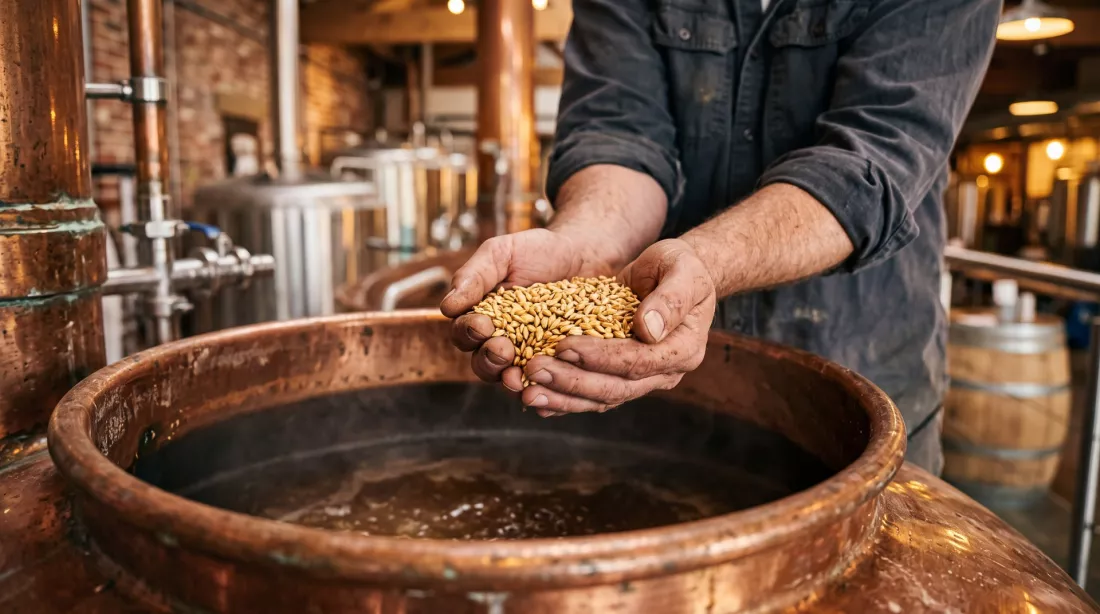
Every brewery produces it by the tonne: the wet, heavy mass of spent malt left in the mash tun once the sugars have been washed out. Usually it ends up as animal feed, or simply as waste. An EU-funded project has just finished asking whether that mass could become a plastic instead — and whether the bottles and trays made from it could later be sorted out and broken back into their building blocks. The answer says a lot about what the word “bio” on a label is actually worth — and at the end you can check how far your own thinking about waste really reaches.
Brewing starts with malted barley soaked in hot water. The sugars dissolve, the liquid goes on to become beer, and what stays behind in the mash tun is a wet, heavy pile of grain husks. Brewers call it spent grain, and every brewery produces it — far more of it, by weight, than anything else it throws away.
Most of it is sold cheaply as cattle feed or simply carted off. It spoils fast, it is expensive to move because it is mostly water, and almost nobody has treated it as a raw material worth engineering around. The EU-funded BioSupPack project, coordinated by the Spanish plastics technology centre AIMPLAS, started from the opposite assumption.
The route runs through bacteria. Fed on sugars released from the spent grain, certain microorganisms build up polyhydroxyalkanoates — PHAs, a family of natural polyesters that they store inside their cells rather as a body stores fat. Harvested and processed, PHA behaves like a rigid plastic.
The hard part was never only the chemistry. Packaging made from renewable material has to protect what is inside it, run through machines built for conventional plastics, and still be recyclable once it is empty. Projects usually solve one of those and leave the rest to somebody else. BioSupPack tied the three requirements into a single value chain, running from the brewery’s waste to the sorting plant.
The project did not stop at pellets of material. Several formats went from the laboratory to a pilot line:
The bottles matter more than they look. Filling a container is a test of the material itself: an oily dressing and a detergent each attack a polymer in their own way, and a bottle that holds one may quietly fail with the other.
The beer bottle display was the piece that left the building. Instead of a short bench trial it went into everyday use in the hospitality trade and stayed there. “This last one was validated in real-use conditions for nearly one year with very positive results and feedback from the end users”, says project coordinator Rosa González Leyba of AIMPLAS.
A year of being knocked, stacked, wiped down and refilled is a different order of evidence from a laboratory report — and it is the kind that decides whether anyone will actually buy the thing.
A new plastic that recyclers cannot recognise is a new problem, not a solution. Mixed plastic packaging waste arrives at sorting plants as a stream of look-alikes, and an unfamiliar polymer in that stream is usually lost among the rest.
So the project built a sorting prototype and turned it loose on mixed plastic packaging waste. It identified and separated more than 95 % of the PHA packaging — enough to say that the material can be pulled back out of the system it goes into.
What happens to PHA after sorting was the second half of the answer. Melting a polymer down again degrades it a little each time, so for this one the team went a different way. “Regarding post-consumer waste, the project addressed enzymatic recycling as the more suitable route for this polymer, recovering the value of the material by obtaining the monomer and reintroducing it in the PHA production process”, explains González Leyba.
Enzymes cut the long chains back into the single units they were built from. Those monomers go back into PHA production, and the material starts over instead of sliding down a grade.
None of this is on a supermarket shelf yet. Fibre-based products still need trials at a larger scale. Food-contact safety testing is unfinished, and it is not work that can be hurried. And the material is expensive.
“The optimisation of PHA production at larger scales in Europe, using different feedstocks, would allow current prices to go down and spread the use of this material in different sectors”, says González Leyba. The team also proposed an online platform to connect European breweries sitting on spent grain with the people who could use it.
BioSupPack, funded under Horizon 2020, took the least glamorous thing a brewery produces and followed it all the way to a bottle, a display and a sorting line — then asked what happens to the material afterwards. The lesson for anyone reading a label is not that bioplastics are good. It is that “bio” on its own says nothing: what counts is what the material is made from, whether it survives real use, and whether anything can be done with it once it is empty.
5 questions · one minute · nothing saved


 EN
EN 
 CS
CS DE
DE ES
ES FR
FR HU
HU IT
IT PL
PL PT
PT РУ
РУ SK
SK TR
TR УК
УК AR
AR 中文
中文