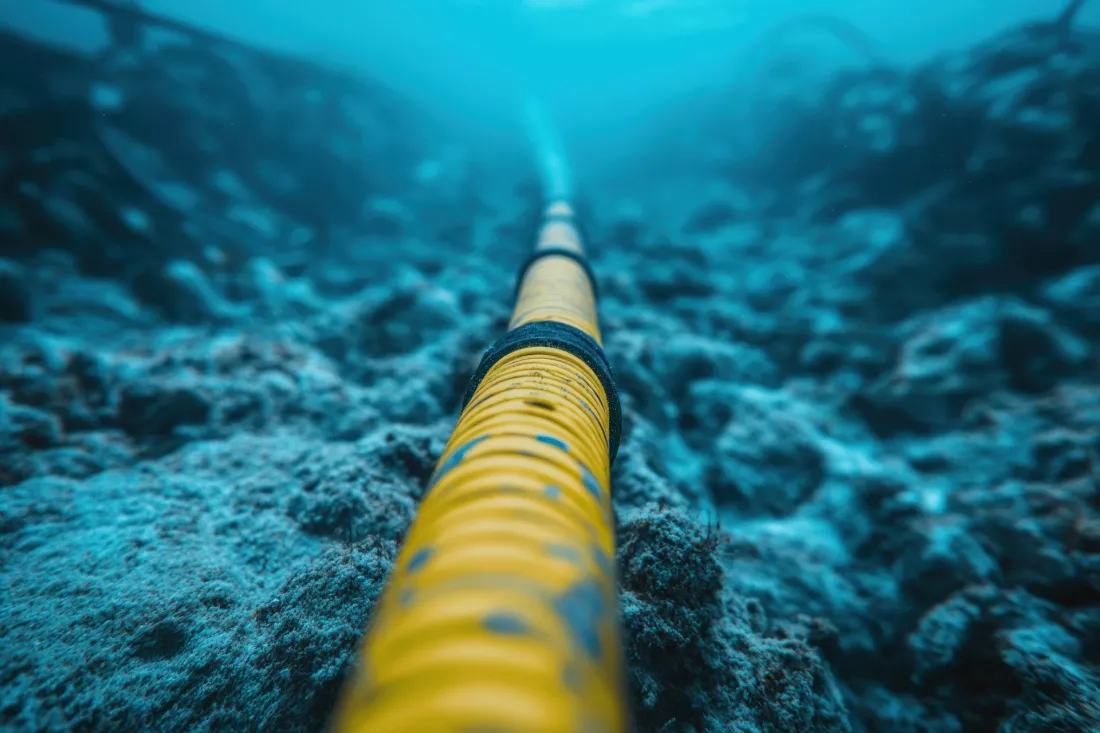
Beneath the oceans lie more than 1.3 million kilometres of fibre-optic cable, and roughly 95% of the world’s internet and voice traffic runs through them. For decades that glass had exactly one job: moving data. Then researchers realised that the same fibre also registers every tremor of the seabed it rests on. The EU-funded SUBMERSE project turned that realisation into a working instrument — and in doing so showed that a new research tool is sometimes just infrastructure nobody had thought to listen to, which is exactly the kind of eye you can test at the end.
Ask where the internet physically is and most answers drift upwards — satellites, clouds, something orbital. The honest answer is far less glamorous: it is mostly lying on the seabed. More than 1.3 million kilometres of submarine fibre-optic cable cross the world’s oceans, and around 95% of global internet and voice traffic travels through them.
These cables went in over decades, quietly, one route at a time, and nobody laid them as scientific equipment. They were built to move traffic, and that was the whole of what anyone expected from them.
The idea behind SUBMERSE starts from a property of the glass itself: the fibre that carries the light is also sensitive to being disturbed. Light travelling down it scatters slightly, and the pattern that comes back changes when the fibre is stretched, squeezed or shaken. A cable resting on the ocean floor is being shaken more or less constantly.
Reading that signal needs one device at one end. The project installed fibre-optic interrogators, built by European companies, in cable landing stations — the buildings on shore where submarine cables come out of the water. Attached to an optical fibre, an interrogator turns the entire length of cable into a distributed sensor. Nobody has to go to sea, and the telecommunications traffic the cable exists for keeps running.
„By doing so, we created a versatile research infrastructure capable of continuously collecting data that can support a wide range of scientific and practical uses,” explains Matías Barberis from the European Future Innovation System (EFIS) Centre, the coordinating partner.
SUBMERSE stands for SUBMarine cablEs for ReSearch and Exploration. It was funded under Horizon Europe in the „Research infrastructures” area, grant agreement 101095055, and ran from 1 May 2023 to 30 April 2026. Total cost and EU contribution were both EUR 9 744 100, and the coordinator was the European Future Innovation System Centre in Belgium.
„Our aim was to create a new type of remote sensing instrument that can give scientists ready access to data from some of the most difficult-to-reach places on Earth,” states Chris Atherton, senior research engagement manager at GÉANT.
One sensor, several very different audiences. The uses the project identified include:
The last item is quietly circular, and rather elegant for it: the cable reports on threats to the cable.
A fibre hundreds of kilometres long produces an enormous amount of raw measurement, so the project also wrote the software for making sense of it and released the analysis tools as open source. Among them is a detector that picks whales out of the signal and works out where they are — which matters for keeping ships and animals apart.
The other half of the problem was moving the data at all. Frederik Tilmann, professor at the GFZ Helmholtz Centre for Geosciences, has pointed out that the system sends its readings onward as they happen and in a stripped-down form, which is what lets it drop into the workflows seismologists already use to analyse and archive earthquakes rather than demanding new ones.
The infrastructure is installed at eight locations, picked because they sit near active seismic zones or along marine mammal migration routes. The project showed that sensors can go in securely without disrupting telecommunications, and the data travels to researchers through European research infrastructures that already exist — above all the European Plate Observing System (EPOS), with integration into the Copernicus Marine Service planned for oceanographic products.
Beyond that there is geographic expansion, work on newer fibre-optic sensing technologies, and agreements with at least three European Research Infrastructure Consortia alongside GÉANT, which is what turns a finished project into something that keeps running.
SUBMERSE did not build a new observatory. It took cable that was already on the seabed, added a box in a building on shore, and got seismology, tsunami warning, whale tracking and cable security out of the same signal. For anyone weighing up a research field, that is the useful lesson: a new instrument is not always new hardware, and the best question to ask about existing infrastructure is what else it happens to be measuring.
5 questions · one minute · nothing saved


 EN
EN 
 CS
CS DE
DE ES
ES FR
FR HU
HU IT
IT PL
PL PT
PT РУ
РУ SK
SK TR
TR УК
УК AR
AR 中文
中文