
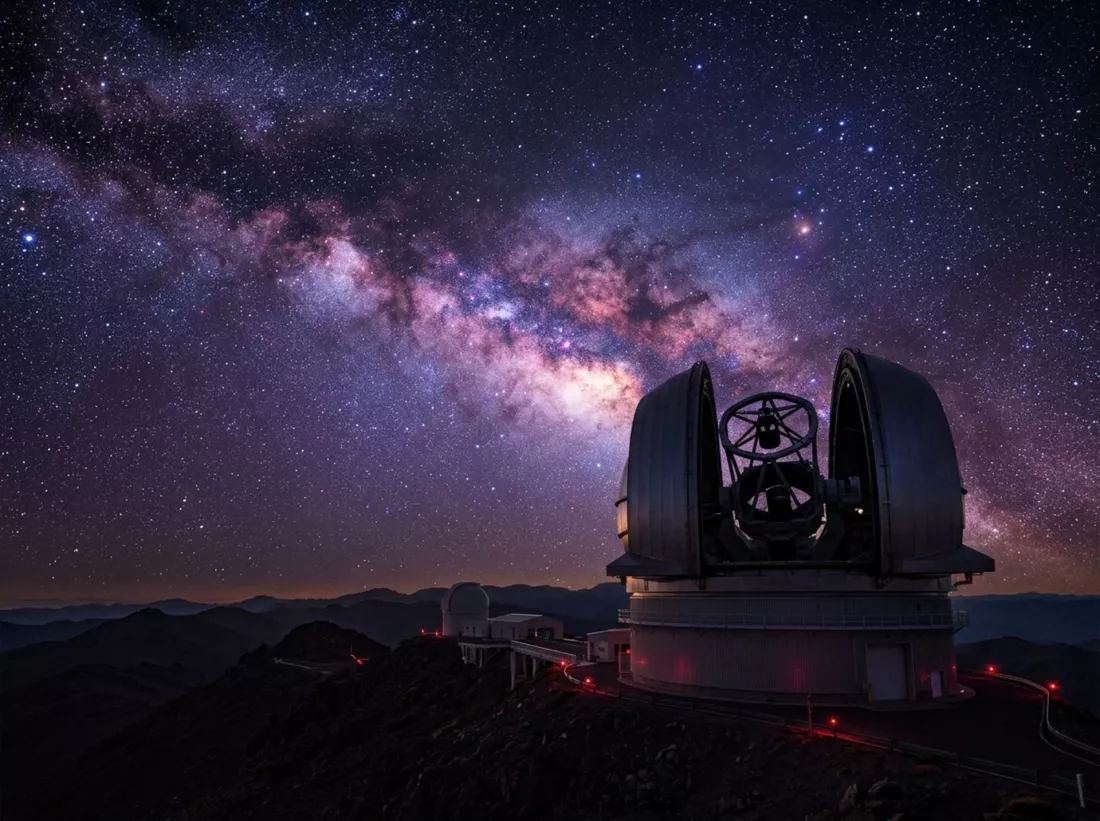
Telescopes keep getting sharper and space missions keep travelling further, yet nobody has found confirmed evidence of life beyond Earth. An international team of researchers suggests that part of the problem may lie in how we look: science worries a lot about claiming life where there is none, and far less about missing real traces. Statistics students call this a false negative – and at the end you can check whether you have the eye of an alien-trace hunter.
Are we alone in the universe? It is one of the oldest questions people ask, and today it is not only philosophers who try to answer it. Scientists use powerful telescopes and space missions to look for life elsewhere, pointing their instruments at distant planets and moons in the hope of catching a hint that something lives there.
So far, though, there is no confirmed evidence. That leaves an uncomfortable possibility on the table. Maybe life really is rare. Or maybe we are looking for the wrong signals, or overlooking – even dismissing – information from distant worlds that already hints at life.
The search for extraterrestrial life rarely produces a clean yes or no. Researchers often face ambiguous data, and they have to sort it carefully into two kinds of possible mistakes.
A false positive happens when the evidence incorrectly suggests that life is present. A false negative is the opposite: actual signs of life are there, but they are missed or go undetected. Anyone who has taken a statistics course, studied medical tests or trained a classifier in computer science knows this pair well. Here the same idea is applied to one of the biggest questions in science.
An international research team decided to look closely at the second kind of error. The researchers explored new techniques for correctly distinguishing false negatives, so that real signs of alien life are not overlooked. Their findings were published in the journal Nature Astronomy.
The lead researcher is Inge Loes ten Kate of Utrecht University, an astrobiologist. “We should be aware of these false-negative results,” she noted. “It means there are shortcomings in recognising the existence of life. These shortcomings are not yet high on the research agenda.”
In other words, the issue is not only technical. It is also about what the research community treats as a priority.
According to the team, there are several reasons why signs of alien life could escape us, even if they exist. The traces may:
Each of these paths leads to the same result: a false negative, where the answer looks like “no life here” while the truth may be different.
The researchers also point to a common bias in the field. Astrobiologists spend more time avoiding false positives – mistakenly claiming to find life because of data errors or instrument problems – than they spend dealing with false negatives, where signs of life go completely unnoticed.
It is easy to see why. Announcing life on another world and then having to take it back would be a huge embarrassment. But caution has a price: if everyone focuses on not saying “yes” too early, a real “yes” can quietly turn into a “no”.
“We therefore advocate for the development of a targeted research strategy,” explained ten Kate. She stressed the need to combine laboratory experiments with modelling research and fieldwork. “Space missions and instruments are designed to detect potential signs of life, but the risk of overlooking something is not taken into account.”
One promising tool is artificial intelligence. Using AI to identify patterns offers an effective way to tackle the problem, because a machine can notice regularities that a human would easily miss.
“Because then you might well uncover things that we would never be able to see on our own,” ten Kate observed. “And with new observations, you can then work out how and where they fit into such a pattern.”
The idea is that each new observation does not have to be judged in isolation. It can be compared with a known pattern, which makes it easier to spot something unusual that deserves a second look.
The deepest difficulty is a very human one. “That question goes to the heart of our problem, because we tend to look for things we already know,” ten Kate concluded.
Life elsewhere does not have to resemble life on Earth. That is why researchers need a better understanding of what kind of life is possible in a particular environment, what conditions it would require and how its traces could be recognised. Even then, there is no guarantee: crucial evidence might still escape detection.
The search for alien life is not only a race for better telescopes. It is also a question of method. By paying as much attention to false negatives as to false positives, combining lab work, modelling and fieldwork, and letting artificial intelligence help with patterns, scientists hope to stop overlooking signs that may already be in their data. For anyone interested in astronomy, biology or data analysis, it shows how a concept from a statistics class can shape one of the biggest questions humanity asks.
5 questions · one minute


 EN
EN 
 CS
CS DE
DE ES
ES FR
FR HU
HU IT
IT PL
PL PT
PT РУ
РУ SK
SK TR
TR УК
УК AR
AR 中文
中文