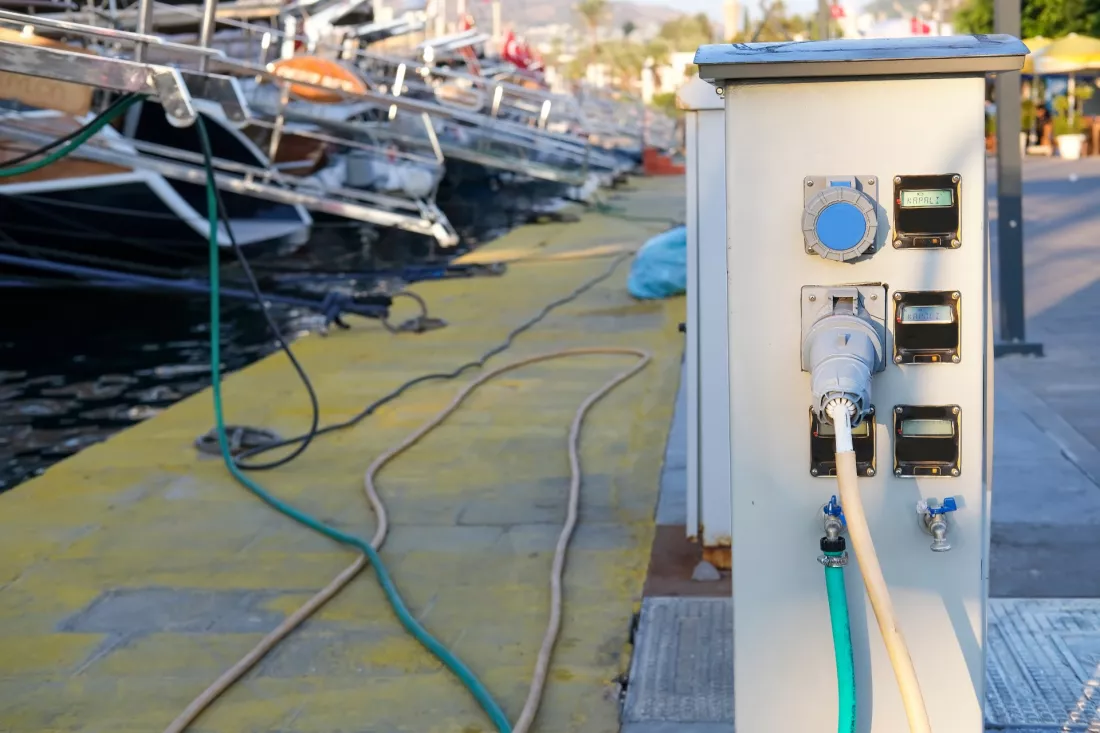
A battery-electric ferry has only a short stop in port to top up its energy, and during that time it keeps moving with the tide and the wind. The EU-funded HYPOBATT project built an automated megawatt charging system that finds the socket, connects quickly, looks after the batteries and helps keep the timetable, tested on a real ferry route — and at the end you can check what kind of traveller you are when the schedule starts to slip.
Battery-electric ferries promise cleaner and quieter crossings. They cut emissions and noise. But there is a catch: a ferry has to recharge during short port stops, and it has to do so without disrupting passengers and without damaging its batteries.
The ports have their own problems to solve. The charging equipment has to cope with vessels that move, with the limits of the local electricity grid and with the fact that ships are not all built the same way. According to the project, this work supports the International Maritime Organization’s emissions strategy and Europe’s expansion of shore-side electricity.
The HYPOBATT project, funded by the EU and coordinated by the research centre IKERLAN, developed a modular multi-megawatt charging system for electric vessels. It is not a single plug but a set of pieces working together: automated connection, power conversion, control that takes the state of the batteries into account, and digital tools for port operations.
The system was not tested only in a lab. Its full-scale maritime case is the Norddeich–Norderney ferry route operated by Frisia.
Parking a car next to a charger is easy – the car simply stays where it is. A ferry cannot line up with a quay that rigidly. Endika Bilbao, HYPOBATT project coordinator and senior researcher in IKERLAN’s Energy Storage and Power Electronics Department, describes the first challenge: “First, the vessel is not fixed: tide movement, wind and mooring tolerances continuously change its position relative to the quay, so the system must align and connect repeatably.”
In other words, the charging system cannot assume that the ship will be in exactly the same place every time. It has to find its target again and again, and connect reliably on each visit.
Once the connector reaches the ship, the hard part is not over. The automated connector has to transfer high current with low resistance, and it has to do this in a salty environment by the sea. Several things decide whether the connection is safe:
The last point is not a detail. Earlier EU-funded research on fully electric ferries showed why charging must begin quickly while passengers and vehicles are still getting on and off.
Ferry schedules rarely run perfectly. Boarding can take longer, manoeuvring can be slow, the weather can turn or the harbour can get congested. Faster charging helps a vessel recover enough energy during its normal stop, so these delays do not have to push the whole timetable back.
Speed alone is not the goal, though. The batteries also have to last. Bilbao puts it this way: “Battery protection was one of HYPOBATT’s critical KPIs, and the project has met this objective by treating fast charging as an energy-management problem, not simply as delivering the highest possible power.”
In practice, the charger control and a digital twin adjust the charging profile to the battery temperature, its state of charge and the power the grid can provide. The ferry gets the energy it needs for the route, while unnecessary stress and loss of battery lifetime are avoided.
Port operators gain something as well: evidence on connection times, availability, grid compatibility and how the system performs under a real ferry schedule.
In its full-scale maritime case, HYPOBATT implemented the Megawatt Charging System (MCS) industry standard. Standardised interfaces and communication matter because ports cannot justify building separate infrastructure for each vessel or each operator. As Bilbao explains: “A common standard reduces investment risk, avoids duplicated infrastructure, and allows charging systems to serve different vessels and operators.”
This approach supports the interoperability sought by the EU’s Alternative Fuels Infrastructure regulation and complements the FuelEU Maritime regulation. Because the system is modular, charging capacity can also be matched to vessel schedules, port layouts and grid conditions.
HYPOBATT shows that charging an electric ferry is as much about port operations as about technology. By coordinating charging windows with renewable electricity, storage and other port loads, high-power chargers could support shared infrastructure and energy service business models. Ports could then become energy hubs that keep electric maritime transport reliable, scalable and easier to invest in.
5 questions · one minute


 EN
EN 
 CS
CS DE
DE ES
ES FR
FR HU
HU IT
IT PL
PL PT
PT РУ
РУ SK
SK TR
TR УК
УК AR
AR 中文
中文