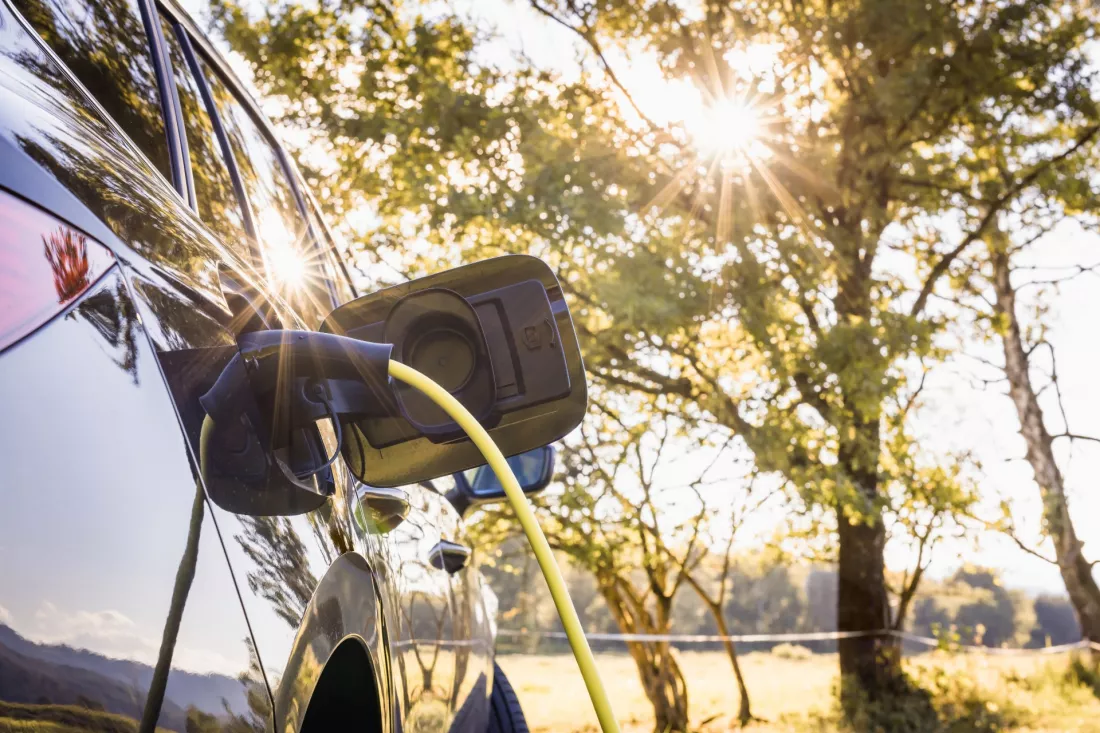
An EU research project ends, the final report is filed – and then what? HiEFFICIENT, which ran from 2021 to 2024, shows that the story can go on: its power electronics for electric vehicles are turning into chargers, inverters, a spin-off company and a follow-up project. It offers a concrete, step-by-step look at how semiconductor research actually reaches real cars — and at the end you can check whether power electronics might be the right field of study for you.
Between 2021 and 2024, the EU-funded HiEFFICIENT project worked on one of the EU’s big goals: sustainable transport for all Europeans. The team focused on electromobility, and more precisely on power electronics – the systems that convert and control the energy flowing between the battery, the motor and the charger. Their material of choice was wide-bandgap semiconductors, used to make these systems more powerful and more reliable.
Since 2024, the partners have kept building on the collaboration the project created, and HiEFFICIENT has moved from research to real industrial deployment. One result drew particular attention: embedding semiconductors directly in printed circuit boards for automotive converters. Carmakers (OEMs) and Tier 1 suppliers from both Europe and Asia have shown strong interest.
Another highlight is a highly compact on-board charger rated at 22 kW. It is bidirectional, so energy can flow into the car’s battery and back out again, and it reaches over 97% efficiency. The charger strengthened the project’s industrial relevance and fed into HiPower 5.0, an EU-funded follow-up project launched in 2025 that aims for even more efficient, compact and reliable solutions.
Several results have already left the lab:
Research results can also become a business. EMAXSIS, a tech spin-off based in Belgium, builds on what HiEFFICIENT achieved. The company specialises in edge-monitoring technologies and Internet of Things software solutions for power electronics.
Work on fast charging continues as well. A next-generation fast-charging power module for electric vehicles is aiming for more than 98% efficiency and full bidirectionality. It is now being industrialised for high-volume production – the stage where a working design has to become something factories can build in large numbers.
Christoph Abart, Senior Program Manager at AVL List GmbH, the company that coordinated the project, puts it plainly: “EU funding was pivotal to HiEFFICIENT’s success, acting as the primary enabler for both technical innovation and cross-sector collaboration.” He also points out that the funding assembled a strong European consortium along the entire value chain, from the semiconductor industry up to leading European carmakers, and lowered the risk of breakthrough research by backing early-stage development that is otherwise hard to finance.
EU support also sped up the maturation and validation of the technology across all partners. The outcome is power electronics with more than 98% efficiency and a lifetime about 20% longer – a direct contribution to Europe’s climate and energy goals.
HiEFFICIENT shows that the end of an EU project can be the beginning of something else. Its wide-bandgap power electronics now live on in a 22 kW two-way charger, motor control software, inverters for future aircraft, GaN components in customer tests, a Belgian spin-off and the follow-up project HiPower 5.0. For anyone considering electrical engineering or electromobility, it is a clear example of research travelling from the lab onto the road.
5 questions · one minute


 EN
EN 
 CS
CS DE
DE ES
ES FR
FR HU
HU IT
IT PL
PL PT
PT РУ
РУ SK
SK TR
TR УК
УК AR
AR 中文
中文