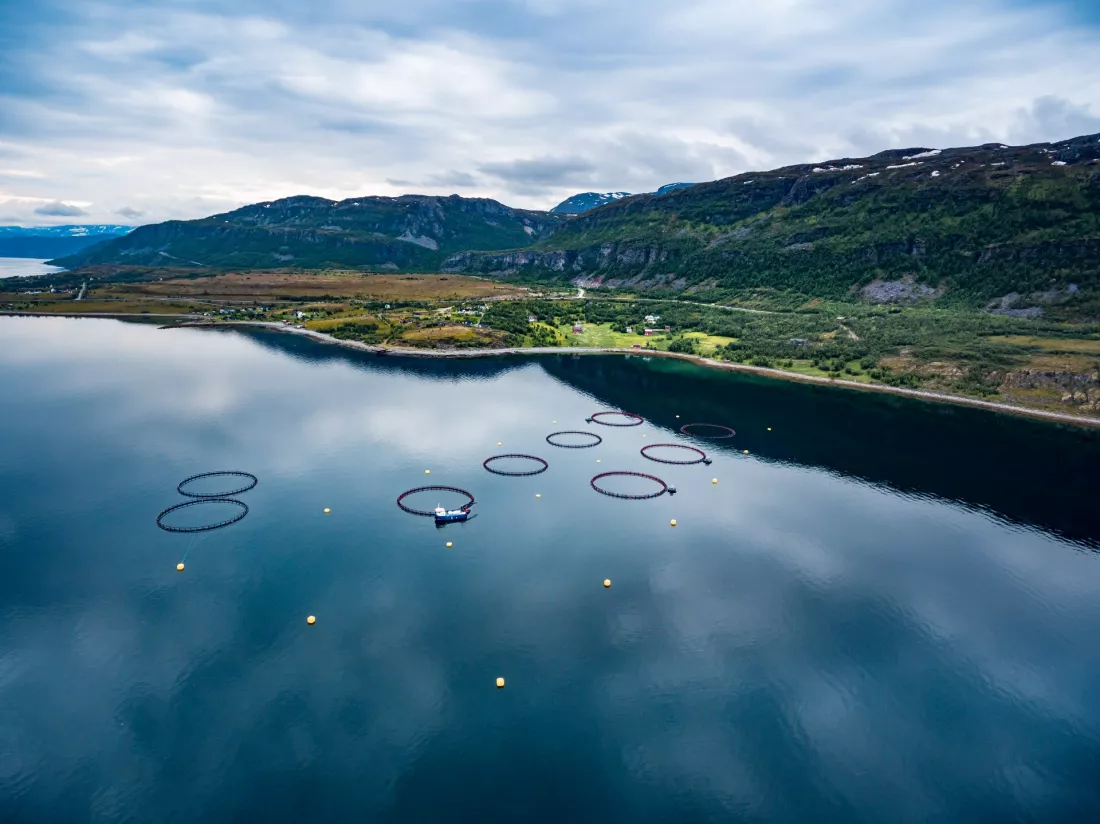
Farmed salmon owe their pink flesh to astaxanthin, and most of that pigment still comes from petrochemical processes. The EU-funded ASTEASIER project engineered microalgae that make it without the stress they normally need, scaled production up with industrial partners and tested the pigment in trials on fish farms. Now a project spin-off wants to take the idea to market — and at the end you can check whether industrial biotechnology could be your thing.
As the world eats more seafood, aquaculture has become an important supplier of protein and omega-3 fatty acids. Shoppers, however, expect farmed salmon to look the part, and that means the familiar pink colour. In nature, that colour comes from astaxanthin, a reddish antioxidant. It is made by aquatic microorganisms in response to stress and then accumulates in the food chain until it gives salmon their characteristic shade.
Salmon farmers therefore depend on astaxanthin added to feed. The real question is where that pigment comes from.
The natural route sounds attractive, but it runs into a practical wall. Matteo Ballottari of the University of Verona in Italy, who coordinated the project, explains: “Producing and extracting astaxanthin from natural sources (such as algae or crustaceans) remains costly and difficult to scale for the volumes required for the salmon industry”. The consequence is spelled out just as clearly: “As a result, around 90 % of the astaxanthin used for feed is produced from petrochemical sources, which raises sustainability concerns.”
There is also a twist worth knowing. Synthetic astaxanthin is not approved for human consumption in the EU, yet it still reaches consumers indirectly, through the feed given to farmed salmon.
ASTEASIER, backed by the European Innovation Council and running from 1 January 2023 to 31 December 2024, set out to change that balance. The team engineered microalgae strains that produce astaxanthin more efficiently – and, crucially, without first having to be put under stress.
“Our strains produce astaxanthin even under non-stress conditions. This helps to reduce costs, which is a major barrier for natural astaxanthin penetration in the market”, says Ballottari.
The work did not start from zero. It built on two earlier projects funded by the European Research Council, SOLENALGAE and ASTEASY. The EU covered the entire project budget of €1,982,688.
Turning a promising lab strain into a product takes more than biologists. “We wanted to construct a complete innovation pathway, from patented strains and laboratory validation to the creation of a dedicated spin-off company,” Ballottari says. The roles were split like this:
The project demonstrated production on an industrial scale, and farm trials confirmed satisfactory pigmentation levels. In other words, the fish looked the way the market expects.
The environmental result matters just as much: the carbon footprint of producing natural astaxanthin this way proved significantly lower than that of synthetic production. This is a good illustration of what industrial technology is really about. A process has to work not only in a flask, but also in large volumes, with steady quality and a sensible environmental balance.
When ASTEASIER ended in December 2024, the story continued in a new form. The team set up a dedicated spin-off company, which was then selected by FoodSeed, an Italian food tech accelerator. “This validates the market potential of the project and will support our transition towards an investment-ready start-up”, Ballottari comments.
The young company is now looking for industrial partners and working through the authorisation processes it needs to enter the market. Money is part of the plan too: “We are also fundraising to continue our entrepreneurial adventure.”
Salmon are only the first target. “In addition to aquafeed, the same technological platform can be applied to other high-value markets where natural astaxanthin is already recognised as an attractive ingredient”, Ballottari points out. He gives examples: “For example, natural astaxanthin is valued for its strong antioxidant properties and potential benefits in areas such as skin protection, anti-ageing, oxidative stress reduction and general health support.”
That puts nutraceuticals, cosmetics and animal health on the list of possible markets, where the same platform could take the place of synthetic pigments.
The pink colour of farmed salmon depends on astaxanthin, and around 90% of the pigment used in feed is made from petrochemical sources. ASTEASIER engineered microalgae that produce it without stress, scaled production up with A4F, confirmed good pigmentation in trials with BIOMAR and showed a much lower carbon footprint than synthetic production. A spin-off supported by FoodSeed now aims to bring the technology to feed and, later, to other high-value markets.
5 questions · one minute


 EN
EN 
 CS
CS DE
DE ES
ES FR
FR HU
HU IT
IT PL
PL PT
PT РУ
РУ SK
SK TR
TR УК
УК AR
AR 中文
中文