Half of a student flat is made of wood-based panels: the desk, the wardrobe, the shelf above the bed. When one of them gives up, it usually ends in a skip, because turning an old fibreboard into a new one is far harder than the word recycling suggests. The EU-funded EcoReFibre project spent four years showing that it can be done at industrial scale, and how - sorting, defibration, mixing ratios, markets - which is also a decent test of how you yourself look at the things around you.
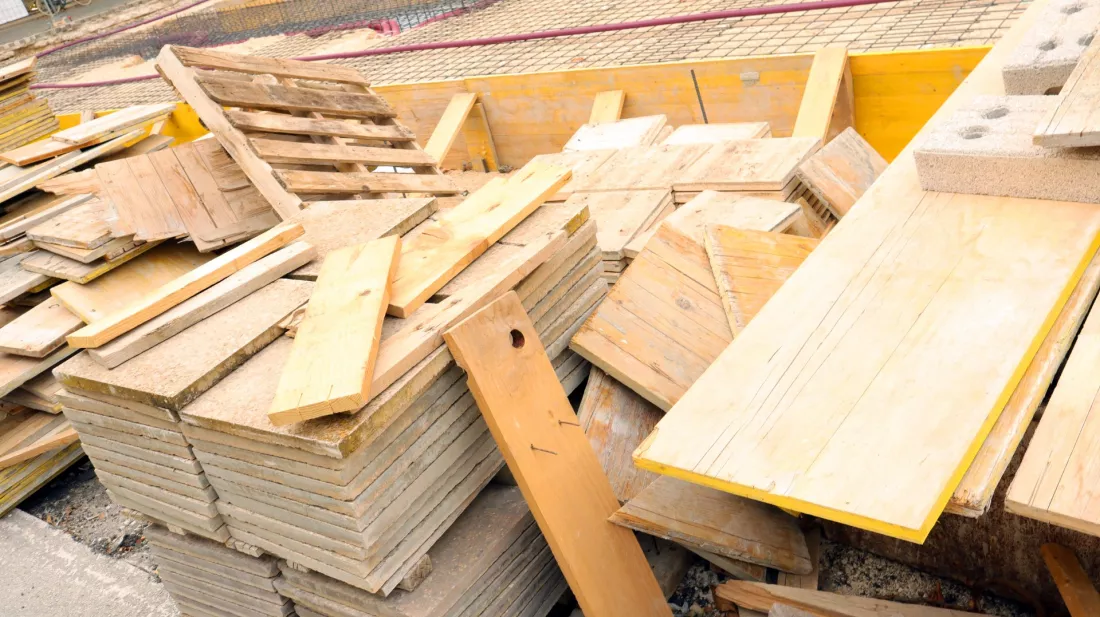
The EU generates nearly 47 million tonnes of wood waste every year, and only around 40 % of it currently comes back as new products. Seen that way, a skip standing outside a building site stops looking like a mess and starts looking like a badly organised warehouse. That is roughly the angle taken by EcoReFibre, an EU-funded project that went after the most awkward part of the stream: fibreboard that has already served its life in somebody’s flat.
A solid plank can be cut, planed and used again. A panel is a different animal. Fibreboard is made of wood fibres bonded into a board, and it is used on a huge scale in furniture manufacturing, interior design and construction - which is exactly why there is so much of it about, and exactly why it does not come apart politely. To get anything useful back, the fibres have to be pulled out of a mixed waste stream in a quality good enough to press into a new board. EcoReFibre started from a sober observation: the potential was there, but industry was waiting for methods proven commercially and at full scale before changing anything.
„Reusing fibres in high-quality materials required new solutions across disciplines,” says project coordinator Stergios Adamopoulos from the Swedish University of Agricultural Sciences. „Our aim was to facilitate smarter material use with an industrially scalable recycling option at high volumes.”
The project, which runs under grant agreement 101057473 from 1 May 2022 to 31 October 2026 with a total cost of €14 819 221.25 and an EU contribution of €11 852 695.51, built its case out of pilots rather than papers. They covered three linked operations: sorting wood waste, defibration, and putting the recovered fibres back to work, including technologies for pulling wood fibres out of waste streams at a quality sufficient for making new fibreboard.
One demonstration went after the part of the stream nobody wants. „The smallest particles in wood recycling, known as fines, are often considered a low-value by-product,” explains Adamopoulos. „One of our pilots showed how they can instead be integrated into new particleboard production.” In that pilot the fines ended up in the surface layers of particleboard - the place where a panel is judged by touch.
This is where recycling stops being a slogan and becomes a number. The point of the demonstrations was to cut reliance on virgin fibres and open the way to recycled fibre making up as much as 25 % of a new fibreboard. Not all of it, not half of it - a quarter, and that share has to survive the press, the strength tests and the accountant.
Alongside the technology the project produced a Strategic Roadmap, which maps the market, names the obstacles and hands out research and policy recommendations. It flags three areas of work. Viable secondary raw material markets have to exist in the first place, meaning somebody has to buy and sell recyclable material at a price that works. Data systems need to improve so that material flows and market information sit in one place. And the technologies themselves - sorting, fibre extraction and cleaning, and panel production from recycled fibre - need further optimisation.
„The technical solutions of EcoReFibre and our Strategic Roadmap are aligned with the goals of the bioeconomy strategy and the upcoming EU Circular Economy Act,” adds Adamopoulos. The reason for keeping the material in play at all, he argues, is simple arithmetic: „Keeping wood in material loops delivers the greatest overall added value.”
EcoReFibre has shown that recycling fibreboard and solid wood waste into high value-added products is technologically and economically viable at industrial level. What is left is the unglamorous part: scaling it up and building a circular economy around panel waste that pays for itself. For anyone drawn to materials, process engineering or industrial design, it is a good illustration of what the job really involves - not one clever invention, but a chain of decisions about sorting, proportions, data and price.
5 questions · one minute · nothing is saved


 EN
EN 
 CS
CS DE
DE ES
ES FR
FR HU
HU IT
IT PL
PL PT
PT РУ
РУ SK
SK TR
TR УК
УК AR
AR 中文
中文