
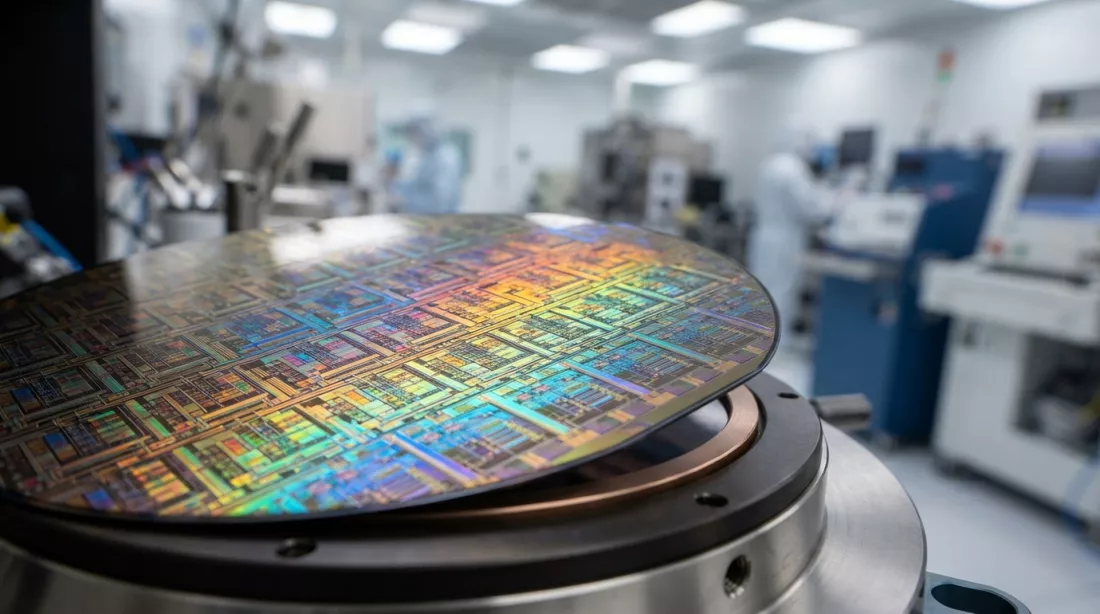
Every photo, message and backup has to sit somewhere, and the world is running out of convenient somewheres. DNA is a tempting answer: huge capacity in almost no space, and it lasts. Writing into it, though, has meant harsh solvents and specialised laboratories. A team in the EU-funded HYPERION project took a silicon chip designed to listen to nerve cells and used it to write 64 DNA sequences at once, in plain water — and then hit a wall somewhere nobody had been looking, which is what the five questions at the end are about.
Data centres are full of spinning disks and flash chips that need power, cooling and replacing every few years. DNA needs none of that. The same molecule that carries the instructions for an entire organism packs information into a volume so small that a shoebox of it would embarrass a warehouse, and it stays readable for a very long time without a power socket. That is why storage researchers keep coming back to it, even though nobody has yet made writing into DNA cheap or fast.
The standard way to build a DNA strand letter by letter is phosphoramidite chemistry. It works, and it has worked for decades, but it runs on aggressive organic solvents and needs the kind of equipment and ventilation that only a well-funded central laboratory has. That pushes synthesis into a handful of specialised places and keeps the price high. If data storage is ever going to run on DNA, the writing step has to leave those rooms.
There is an alternative, and nature has been using it all along. Enzymes assemble DNA in water, at mild temperatures, with no solvents involved, and enzymatic synthesis tries to borrow that trick for the laboratory. It is cleaner, gentler and far easier to place next to ordinary electronics. Woo-Bin Jung, one of the study’s co-lead authors, put the stakes plainly: “DNA data storage asks DNA synthesis to operate at a scale far beyond today’s needs.” The conclusion follows from it — “That is why enzymatic synthesis in water can matter.”
The hardware in this story did not start out as a DNA writer. It began as a semiconductor chip built to sit under living nerve cells and pick up their electrical chatter, an instrument for neuroscience rather than for chemistry. Its entire design is about placing and controlling tiny currents very precisely, at a great many points at once.
That precision turned out to be transferable. “At a certain point, we wondered whether that same current control could be redirected from cells to molecules – replacing the neuron-facing electrodes with ring-electrode pairs that could localise pH for DNA synthesis,” said Donhee Ham, the Harvard professor and senior author of the study, published in Nature Electronics. The team, working within the EU-funded HYPERION project, swapped the neuron-facing electrodes for pairs of ring electrodes and pointed the chip at molecules instead.
The mechanism is easier to follow than it sounds. Enzymes are fussy about acidity, so whoever controls acidity in one exact spot, and nowhere else, controls where DNA grows.
Sixty-four is a modest number next to a hard drive, but it is several times the previous ceiling of roughly a dozen sequences. Han Sae Jung, the other co-lead author, summed up the electronics side: “The chip did what we asked it to do: it localised low pH at selected sites.”
The obvious next move is to pack the synthesis sites closer together and write more sequences at once. When the team tried, something gave way — but not the part anyone expected. Between the growth steps, protective groups have to be stripped from the ends of the strands, and the intermediate molecules involved in that step drift. Crowd the sites and they begin spilling into each other’s territory. “The limitation came from the deprotection chemistry, not from the silicon,” said Han Sae Jung. The electronics still had room to give; the chemistry did not.
Look at what it took to get here. Someone had to design the chip, someone had to understand the enzymes, and someone had to know what 169 bytes of data actually means and how to encode it into four letters. Electronics, chemistry and computer science each solved one piece, and none of them could have done it alone — which is also why the interesting jobs in this area tend to sit between departments rather than inside one.
The second lesson is about the result itself. The headline finding is a number, but the useful finding is a correction: the bottleneck was not where the team assumed it was. Discovering that you have been optimising the wrong thing is not a failed experiment. It is often the most valuable sentence in the paper, because it tells everyone else where to aim next.
Working within the EU-funded HYPERION project, researchers turned a chip designed for listening to neurons into a device that synthesises 64 DNA sequences at once in water, encoded 169 bytes of text with it, and published the result in Nature Electronics. The number matters less than what stopped them from going further: deprotection chemistry rather than silicon. Knowing which of the two is the real wall changes what anyone builds next.
5 questions · one minute · nothing is saved


 EN
EN 
 CS
CS DE
DE ES
ES FR
FR HU
HU IT
IT PL
PL PT
PT РУ
РУ SK
SK TR
TR УК
УК AR
AR 中文
中文