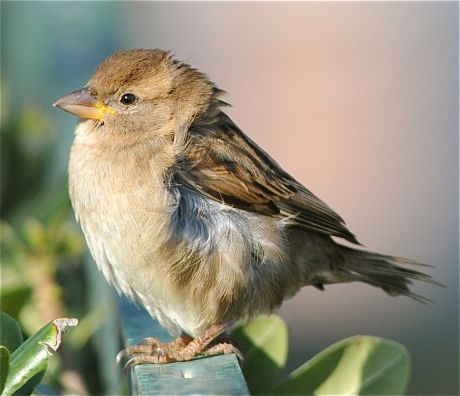
Passer italiae Rome
By Claudio Gennari from Roma, Italia (accrue bird ...) [CC BY 2.0 (http://creativecommons.org/licenses/by/2.0)], via Wikimedia Commons
Researchers are using a sparrow hybrid, which recently evolved from a cross between two different sparrow species, to understand the genetics behind speciation.
Hybrid speciation occurs when two related species mate or hybridise, eventually creating a new species that does not reproduce with either parent. The Italian Sparrow (Passer italiae), a cross between the House Sparrow (P. domesticus) and Spanish Sparrow (P. hispaniolensis) is one such example.
The EU-funded ARCHIGENE (The genetic architecture of secondary sexual traits during hybrid speciation) project aimed to determine how traits introduced by hybrid speciation are genetically controlled.
Using the Italian Sparrow as a model, ARCHIGENE wanted to see how genes controlling sexual traits differ between the parent and hybrid species. As the hybrid’s appearance is influenced by its genetic background, mixing of genes between the two parent species could affect the hybrid’s ability to reproduce.
Since sparrows use plumage colouration to recognise each other and to select mates, researchers studied how the genetic makeup controlling plumage changed during hybrid speciation. They also looked at traits like beak dimension, sexual organs and sperm morphology to determine how hybrids become reproductively isolated to form new species.
They found that the contribution of genes from each parent species had no effect on variation in the hybrid species’ beak shape and height. Since sparrow populations with differing beak heights reproduce less with each other, beak variation may be a way in which speciation occurs.
Ultimately, researchers concluded that traits in hybrid species may be relatively unconstrained by their genetic background, allowing them to rapidly adapt to new environments. This ability to adapt is probably what enables a new hybrid species to survive and evolve in competition with the original parental species.
ARCHIGENE's contribution to the mechanisms behind speciation stands to stimulate further research in the field of evolutionary biology and the role of hybridisation in evolution.


 EN

 CS
 DE
 ES
 FR
 HU
 IT
 PL
 PT
 РУ
 SK
 TR
 УК
 AR
 中文