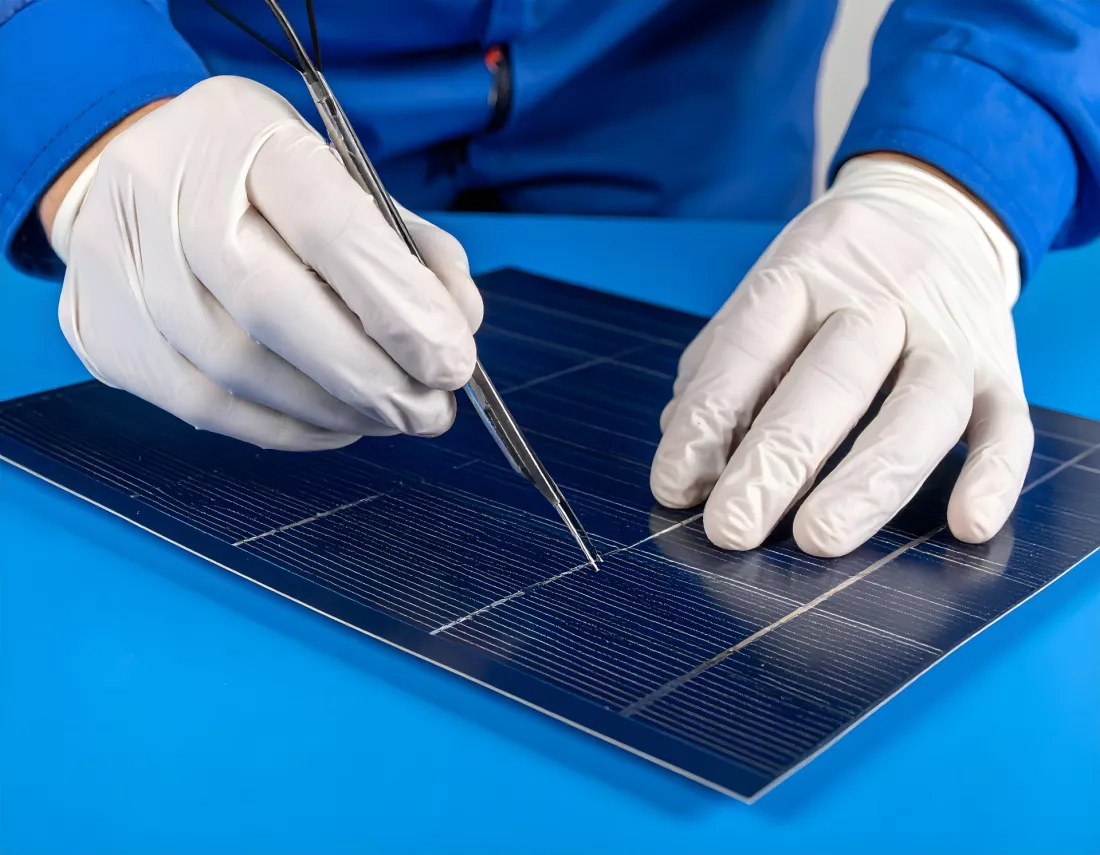
A solar panel usually brings to mind a heavy slab of glass bolted onto a roof. The technology behind the EU-funded DIAMOND project points somewhere else entirely: to a thin film of crystals that captures light more efficiently than silicon and could be made in Europe instead of shipped in. Behind that film sit whole degree programmes, from solid-state physics to materials chemistry and process engineering - and a short test at the end asks how close the reader already stands to that kind of work.
The CORDIS article asks how a printer could power itself. It is a deliberately odd question that breaks the picture most people carry around of what solar power looks like: a heavy sheet of glass and metal, hauled up a ladder and bolted to a roof. The subtitle says it plainly: a new generation of thin-film solar panels, with improved efficiency and a smaller carbon footprint, and made in Europe.
Perovskite is the name of a crystal structure, not of a single substance. It describes one way atoms can arrange themselves in a repeating pattern, and a whole family of compounds can be persuaded into it. Several of them turn out to be remarkably good at absorbing light and letting the freed charge move. Perovskite solar technology, as the DIAMOND project describes it, uses a thin film of crystals to achieve highly efficient energy capture.
The word thin is doing a lot of work there. A conventional cell needs a comparatively thick, very pure slab of semiconductor, grown slowly and then cut. A film can instead be deposited onto a support in a layer a small fraction of that thickness. Less material per cell means less energy spent producing each one.
Existing silicon technology, the article notes, is reaching its theoretical limit. Every semiconductor has a band gap: a minimum amount of energy a particle of light has to carry before it can knock an electron loose. Photons below that threshold pass straight through and do nothing. Photons above it do free an electron, but the surplus is lost as heat almost immediately. Sunlight arrives as a broad mixture of energies, so a cell built from one single material always discards part of the spectrum at both ends.
That loss can be calculated from physics alone, before anybody builds anything: it sets a ceiling on how efficient a single-material cell can ever be, and decades of refinement have brought silicon close enough to that ceiling that the remaining gains come in slivers. Going further means changing the material, not tuning the factory.
The EU-funded DIAMOND project, coordinated from Germany by Uli Würfel, set out to advance the development of perovskite solar technology. "We were delighted to record a solar cell PCE rate of just above 27 %, beating the world record for crystalline silicon solar cells at the time," says the coordinator. PCE stands for power conversion efficiency: the share of the energy landing on a cell that leaves it again as electricity. A laboratory record in it is a statement about what a material can do, not yet about what a product does on a roof.
A record cell is a starting point rather than a finish line. Several conditions have to hold at the same time before the same chemistry turns into something anyone can buy, and the project names them itself:
That last point deserves a sentence of its own. A panel produces clean electricity, but it also costs energy to manufacture, and that debt has to be repaid by the power it generates before the installation counts as a net gain. Thinner layers and gentler processing shorten the repayment.
Almost all production currently takes place in Asia, and solar power is a key element of the EU climate neutrality goals. A region that intends to run on sunlight, and buys the hardware for it from one part of the world, has swapped one dependency for another.
The coordinator draws that line explicitly: "Our results reinforce the potential of perovskite PV technology, which when transferred to industry, will create new jobs and reduce dependency on imports of PV panels and ultimately energy itself." The interesting phrase for a student is transferred to industry. Between a record cell and a production line stand process engineering, encapsulation, testing and people who can scale a coating step from a laboratory bench to a moving web of material.
Its substance is one number and a direction of travel, and the direction matters more. A thin layer of crystals, cheap to deposit and light to carry, moves solar power away from the heavy roof panel and towards surfaces nobody treated as energy sources. Whether it gets there depends on stability, cost, emissions and on where the factories end up standing. For anyone weighing up solid-state physics, materials chemistry or process engineering, that is a fair description of the coming years in this field.
5 questions · one minute · nothing is saved


 EN
EN 
 CS
CS DE
DE ES
ES FR
FR HU
HU IT
IT PL
PL PT
PT РУ
РУ SK
SK TR
TR УК
УК AR
AR 中文
中文