
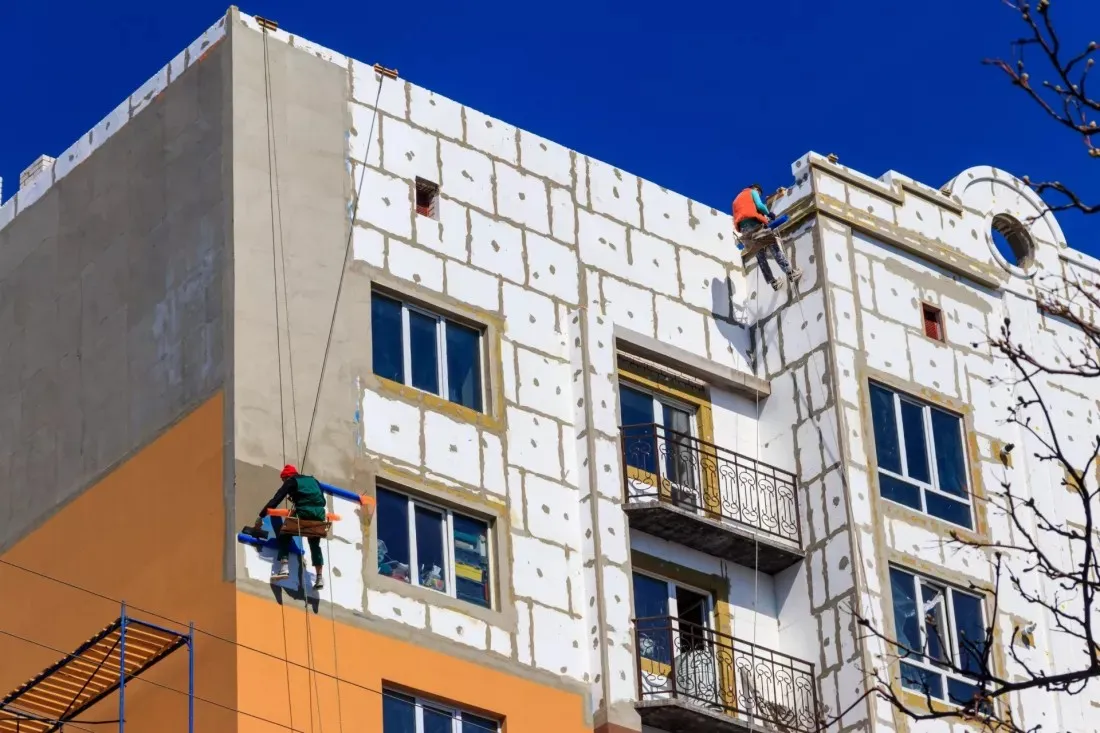
Insulated walls and new windows sound like good news for anyone renting a room. But across Europe, energy renovations can also push rents up and leave the most vulnerable behind. The EU-funded PREFIGURE project is studying local initiatives that manage to make homes energy-efficient, affordable and inclusive at the same time – and at the end you can check how energy-smart your own way of living is.
Renting a room, paying the electricity bill, topping up for heating – for many students this is the first real encounter with the costs of living independently. An article published by CORDIS shows that this problem has a European dimension. Across the EU, housing costs are on the rise, affordable homes are in short supply and energy is becoming more and more expensive.
At the same time, new energy renovation policies are being drafted to meet the EU’s ambitious climate targets. And here is the catch: if they are not carefully designed, such policies could further increase rents, reinforce social inequality and exacerbate energy poverty. A freshly insulated building does not automatically mean lower costs for the people who live in it.
This tension is the focus of PREFIGURE (Prototypes for addressing the housing-energy-nexus), an EU-funded project launched in 2024. Its team wants to unlock alternative pathways to housing in Europe that is affordable, inclusive and energy-efficient all at once.
The long-term goal is a scalable blueprint for climate-neutral housing that leaves no one behind. The project is coordinated by the Karlsruhe Institute of Technology in Germany, where Michael Janoschka is a professor.
Instead of starting from big government programmes, the researchers look at local, bottom-up initiatives. They are conceptualised as ‘prototypes of change’: initiatives that combine social, political and economic innovation to renovate affordable housing for vulnerable communities.
The team identifies and analyses practices in which three goals meet:
PREFIGURE is conducting participatory research in 11 European cities – from Amsterdam and Barcelona to Thessaloniki and Tallinn. The researchers document and analyse 16 distinct prototypes and look at the legal, financial and cultural factors that support or hinder them. Twelve of these prototypes are discussed in depth in a report.
This approach is meant to produce a holistic understanding of how to successfully replicate and scale up energy-efficient renovations. It also fosters learning communities that pass knowledge on and can provide a proven blueprint for housing policies that treat climate goals and social justice as equally important.
The project already has several important results. The first is a shared analytical framework for understanding the link between housing and energy from a social justice perspective. Thanks to it, researchers can compare how different local contexts deal with the combined challenges of decarbonisation, affordability and inclusion.
The second is the Prototype Catalogue – a structured, comparative compilation of innovative practices at the crossroads of housing and energy. For anyone studying urban planning, sociology or energy engineering, it is a good illustration that technical and social solutions can no longer be separated.
The most visible part of PREFIGURE is its mobile participatory lab, called corner to meet you!. It works as a tool for knowledge exchange and as a vibrant space where science and society can meet, connect and spark dialogue.
The team has planned a European tour for the lab: Sofia, Thessaloniki, Barcelona, Amsterdam, Copenhagen, Karlsruhe and, as the final stop, Tallinn. The idea is to foster dialogue between researchers, residents, policymakers and local stakeholders – right where people actually live.
The project team is also analysing the results of a large-scale comparative survey involving more than 25 000 respondents across seven countries.
“This exceptional dataset provides one of the most comprehensive cross-national pictures to date of how households experience the links between housing, energy affordability, renovation pressures and social inequality,” says Michael Janoschka. He adds: “These findings will be highly valuable, not only for local and national decision-making in the participating countries, but also for informing policy debates at EU level.”
Students usually rent and pay their bills from a limited budget, so the question of who pays for green renovation affects them very directly. When looking for a place to live, it is worth asking not only about the rent but also about heating costs and the condition of the building.
Projects like PREFIGURE are a reminder that climate policy is also about the everyday expenses of tenants. They also show how many disciplines meet in a single topic: engineering, law, finance and social research all have something to say about one block of flats.
By the end of the project in 2027, PREFIGURE aims to show how Europe can decarbonise its housing stock without losing sight of affordability, inclusion and social justice. Janoschka sums it up: “In doing so, PREFIGURE will reinforce the EU’s ambition to achieve climate neutrality while ensuring that no one is left behind.”
5 questions · one minute


 EN

 CS
 DE
 ES
 FR
 HU
 IT
 PL
 PT
 РУ
 SK
 TR
 УК
 AR
 中文