
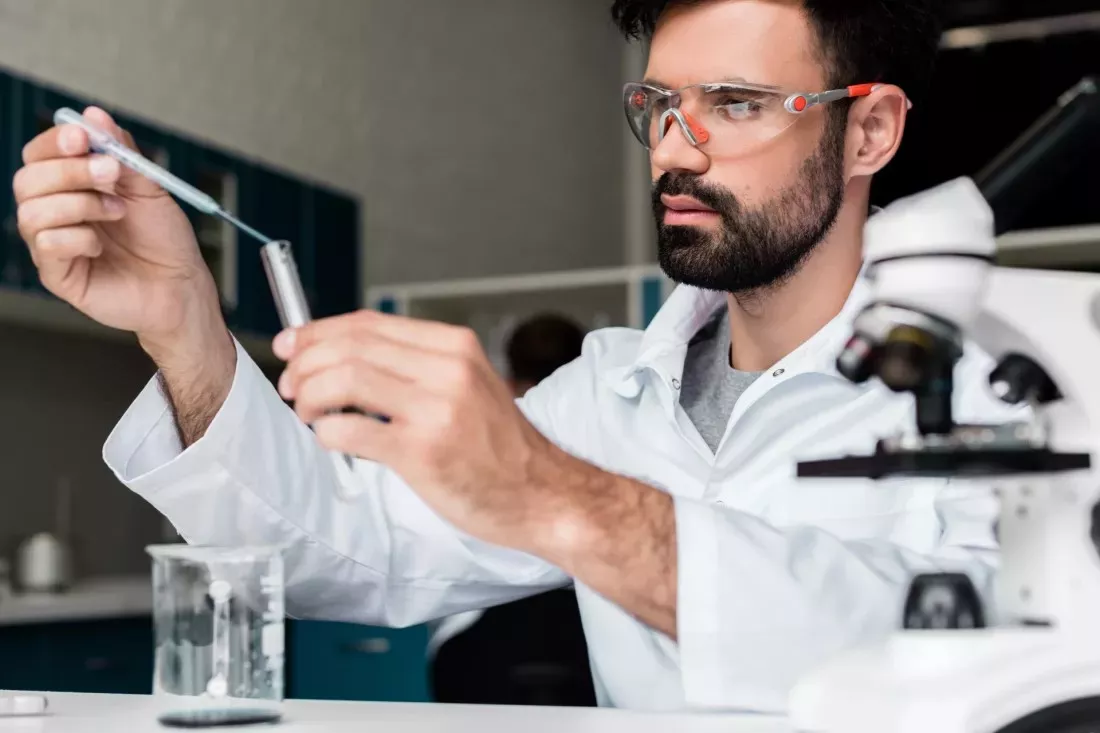
The human brain works entirely through chemical reactions, yet it is often called the most powerful computer in the world. The EU-supported CORENET project tested whether a similar principle can be used in the lab: networks of chemical reactions in microfluidic reactors processed data, and artificial intelligence read the answers from them. It is a field where chemistry, computer science and data analysis meet at one table – and at the end you can check whether this way of working suits you.
When people think about computers, they usually picture processors, cables and screens. The material published by CORDIS starts with a different comparison: the most powerful computer in the world is the human brain, and it runs entirely on chemical reactions. That leads to the question asked by the researchers behind the European CORENET project – can chemistry serve as the model for a completely new kind of computation?
The project, supported by the EU and funded by the European Innovation Council, is constructing computing devices that mimic the brain. In them, information is processed by networks of chemical reactions, known as CRNs. Molecules become the carriers of data, and the way they change becomes the way that data is processed. The work is part of a wider drive by EU-funded projects to advance machine learning.
Wilhelm Huck, professor and lead of the CORENET team at Radboud University in the Netherlands, explains the idea: “We were inspired by the human brain, itself a chemical processor. So we set out to demonstrate that dynamic reaction networks, contained within microfluidic environments, can perform high-level computational tasks.”
The technique the scientists used is called reservoir computing. The team implemented it on microfluidic chips – tiny reactors through which chemicals flow. The starting point is a chemical input layer made up of:
Together, these elements form the reservoir. The reactions start from simple feedstock molecules with one or two carbon atoms and then expand the chemical space, generating dozens of compounds that are structurally more complex.
The key point is that the outcome of the reactions is not random. The input conditions are correlated with the composition of the products, so different settings at the start give a different pattern of molecules at the end. This chemical response can then be analysed.
This is where artificial intelligence and machine learning step in. The algorithms extract meaningful information from the chemical response. In practice, the reactions do part of the computational work, and the AI tools help to read what it means.
A central outcome was the successful development and automation of chemical reservoir computing workflows. Chemical inputs flowing through microfluidic reactors produced non-linear outputs, which were analysed and interpreted to solve classification and prediction tasks – the kind of problems familiar to anyone who has worked with machine learning.
The researchers also established protocols for controlling, monitoring and steering these reaction networks. According to the material, this is a significant step towards scalable, molecule-based computing.
The results were described in a landmark article in “Nature” titled “Chemical reservoir computation in a self-organizing reaction network”. It showed how formose reactions and related systems can act as molecular computing substrates. Follow-up work is being finalised: it is meant to show that the concept can be generalised, with a performing reservoir computer built on a newly developed reaction network.
CORENET shows how the borders between fields of study are fading. Project coordinator Andres de la Escosura, associate professor at the Autonomous University of Madrid, stresses that success came from many specialisations working together: “We were thrilled by how successful the approach was and how our extraordinary group of academic and industry scientists came together to take on this grand challenge of combining systems chemistry, microfluidics, metabolomics and AI.”
For anyone choosing a degree or a specialisation, there are a few lessons here. A chemist who understands data analysis can end up in a team working on the future of computing. A computer scientist or machine learning specialist can find interesting work where the data comes not from a screen but from a microreactor. It is also worth noticing that academic and industry scientists worked side by side, so research like this is not locked inside university walls.
Looking at what the team worked on, several areas of knowledge meet in such projects every day: reaction chemistry and catalysis, microfluidics, the analysis of chemical mixtures and machine learning. Nobody has to master all of them at once, but it is easier to find your place in such a team if you understand the language of neighbouring fields.
CORENET is an attempt to build computing devices in which chemical reactions process information, following the example of the human brain. The researchers showed that reaction networks in microfluidic reactors produce responses that artificial intelligence can turn into solutions to classification and prediction tasks. Work like this needs people from different fields, from systems chemistry to AI.
This article is based on material published by the European Commission’s CORDIS service.
5 questions · one minute


 EN

 CS
 DE
 ES
 FR
 HU
 IT
 PL
 PT
 РУ
 SK
 TR
 УК
 AR
 中文