
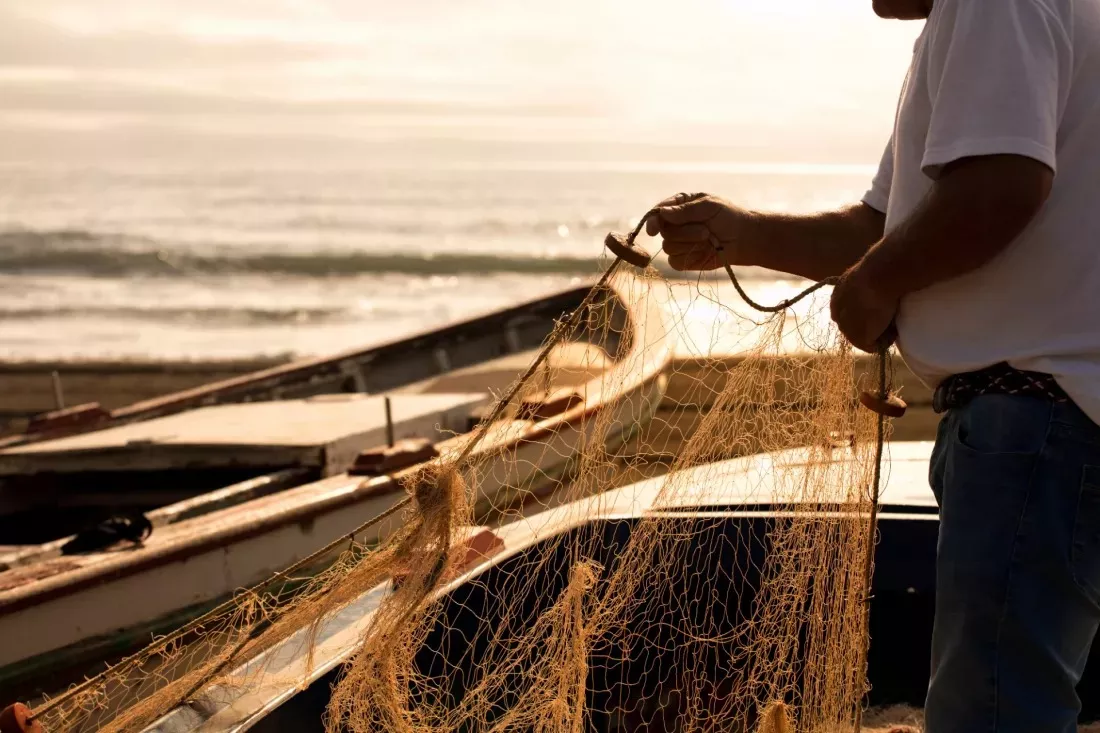
A lost fishing net does not simply disappear on the seabed. According to expert estimates, abandoned, lost or discarded fishing gear makes up around 10% of all marine litter. The European NETTAG+ project, coordinated by researchers at the University of Porto, tackles it from several angles at once: workshops for fishers, acoustic tags for gear, sonar combined with artificial intelligence and underwater robots — and at the end you can check how much responsibility for the sea there is in your own habits.
Anyone who has spent time by the sea has seen a piece of rope or a tangle of netting washed up on the beach. That is only the visible part of the problem. Nets, traps and lines that stay in the water after breaking loose, being lost or being thrown away can threaten animals and ships for a long time. CORDIS cites estimates that such abandoned, lost or otherwise discarded fishing gear, known as ALDFG, accounts for around 10% of all marine litter.
Sandra Ramos, a biologist at the Interdisciplinary Centre of Marine and Environmental Research of the University of Porto (CIIMAR) and coordinator of the NETTAG+ project, points out that this is not only about nature: “This ‘ghost gear’ not only poses a direct threat to Europe’s marine life, it can also disrupt maritime navigation and thus have a socio-economic impact too.”
The EU-funded project does not bet on a single miracle invention. The team combined education, electronics, data analysis and robotics, because each of these approaches answers a different part of the problem. Ramos puts it this way: “Our goal is to develop and demonstrate complementary and innovative solutions that can prevent, avoid and mitigate the harmful impacts of fishing gear and marine litter derived from fisheries.”
In practice, the work followed four main lines:
The first line is the least technical, and it may turn out to be the most important. The team ran workshops, virtual reality events and information campaigns that presented professional fishers as guardians of the ocean. Together with the fishers, the project produced a best-practice handbook on sorting and storing the litter they collect during normal fishing activities.
The project also published a white paper on reward programmes for fishers who collect marine litter. As Ramos explains: “This paper provides insights to inform the design of scalable, policy-aligned reward schemes that recognise fishers for bringing marine litter to fishing ports where it can enter the circular economy.” The logic is simple: if bringing rubbish back to port pays off, it is easier to change everyday habits on board.
The second pillar is MyGearTag, a market-ready, affordable and easy-to-use acoustic gear location system. It helps fishers find a net or other equipment before it turns into yet another piece of ghost gear. Ramos gives specific figures: “MyGearTag enables fishers to rapidly locate and recover lost fishing gear at distances exceeding 2 km and depths greater than 650 m, reducing gear replacement costs, recovery efforts, search time and the environmental impacts associated with ALDFG.”
The system was successfully demonstrated in Croatia, Italy, Portugal, Spain and the United Kingdom, across different types of fishing gear. Project partner Succorfish is now bringing it to market.
A tag helps when a net has been fitted with one in advance. But what about the gear that has been lying on the seabed for a long time? The third element of the project answers that question: a system combining high-resolution sonar imaging, artificial intelligence algorithms and autonomous robotic platforms to detect, map and track ghost gear. The sonar scans the seabed, the algorithms help pick out lost gear in the images, and the autonomous platforms make it possible to follow its trail.
Ramos explains what the team is aiming for: “The idea is that the system will eventually support large-scale ALDFG monitoring and recovery operations.” Scale is the key word here, because fishing out individual nets by hand cannot keep pace with the problem.
The last line of work concerns marine megafauna, meaning large sea animals. The team developed an acoustically activated release mechanism that supports ropeless fishing, as well as a real-time cetacean detection system. Fewer ropes in the water column mean fewer chances for animals to become entangled.
NETTAG+ shows well what work on environmental problems looks like today. A single project brings together biologists, acoustic engineers and specialists in artificial intelligence and robotics, but also people working in education, communication and economics. Without the latter, even the best tag would stay in a warehouse, because it is the fishers who have to want to use it.
For students of oceanography, biology, computer science, automation or management, this is a signal that it is worth looking for courses and student research groups at the crossroads of disciplines. The ability to talk to the people a solution is meant for can be just as valuable as knowing the algorithms.
According to expert estimates, abandoned, lost and discarded fishing gear makes up around 10% of marine litter. The NETTAG+ project tackles the problem on several fronts at once: awareness-raising and rewards for fishers, acoustic tags that work at distances of over 2 km and depths of over 650 m, sonar with artificial intelligence algorithms, autonomous robots and technologies that protect cetaceans. In the coordinator’s view, thanks to greater awareness, good practices and innovative tools, fishers and the fishing sector are now positioned to play a leading role in restoring our oceans and waters.
This article is based on material published by the European Commission’s CORDIS service.
5 questions · one minute


 EN
EN 
 CS
CS DE
DE ES
ES FR
FR HU
HU IT
IT PL
PL PT
PT РУ
РУ SK
SK TR
TR УК
УК AR
AR 中文
中文