
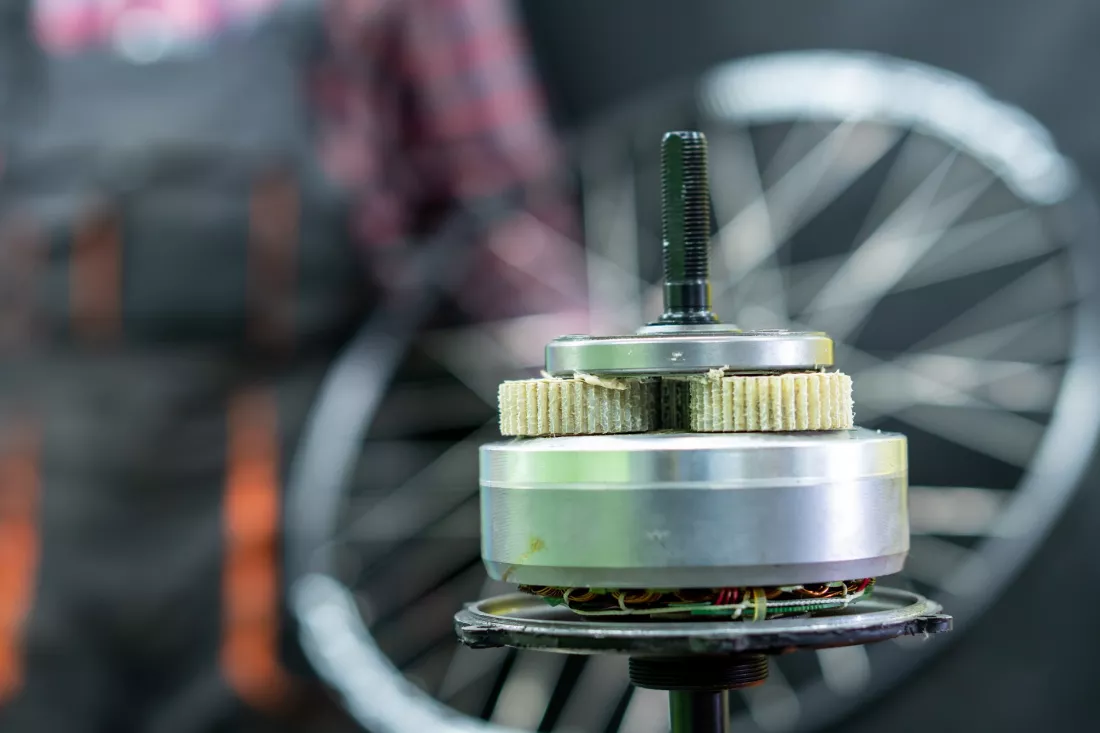
Wind turbines, electric vehicles and mobile phones share a hidden ingredient: magnets made with rare earth elements. Yet less than 1 % of REE magnets in Europe are currently recycled. The EU-funded REEPRODUCE project is testing how to take them out of end-of-life products, such as electric scooter wheels, and turn them into new metals in a way that makes economic sense – and at the end, you can check what you do with your own old electronics.
Rare earth elements, or REEs, are a group of 17 critical metals. The name may sound exotic, but they end up in devices we know well: wind turbines, electric motors, industrial motors and mobile phones.
Their key job is magnetism. “REEs are an important component in the strongest permanent magnets that exist today,” explains Ana Maria Martinez, coordinator of the REEPRODUCE project at SINTEF in Norway.
That strength is exactly what makes them so valuable. “They are so strong that even small amounts give you the magnetic properties you need,” she adds.
With metals this important, you might expect Europe to recover them on a large scale. It does not. “There is untapped potential here, with less than 1 % of REE magnets in Europe currently being recycled,” says Martinez.
In other words, most magnets locked inside old devices never make it back into use. This is where REEPRODUCE comes in: the EU-funded project aims to boost Europe’s recycling capacity and to demonstrate that REE recycling can be economically viable.
The project developed pilot technologies for every step a magnet has to take before it can be used again:
Each step solves a different problem, from finding the right devices in a pile of waste to turning recovered material back into metal.
Recycling rare earths is not simply a matter of melting down scrap. “It is a complicated value chain and market. But there are also economical and security risks in not having a reliable and resilient REE value chain in Europe,” Martinez points out.
Recycling therefore brings environmental benefits and, at the same time, fits with EU policy on critical raw materials, including the Critical Raw Materials Act.
The team also worked out when such a business makes sense. “We calculate that a recycling plant would need to extract a minimum of 1 000 tonnes of REE magnets a year to be economically viable,” says Martinez.
Her conclusion is simple: “We need to extract as many magnets as possible from the discarded products.” The more old devices that reach recyclers, the closer Europe gets to that threshold.
REEPRODUCE shows how many fields meet around a single magnet: robotics for extraction, chemistry and metallurgy for processing, and economics for working out whether it all pays off. It is a topic where engineers and economists need to speak the same language.
Rare earth elements are at the heart of the strongest permanent magnets, yet less than 1 % of REE magnets in Europe are currently recycled. The REEPRODUCE project is testing the whole chain: sorting, robotic extraction, a hydrometallurgical pilot with a capacity of 70 tonnes a year and a prototype producing 22 tonnes of REE metals a year. To be economically viable, a recycling plant would need at least 1 000 tonnes of REE magnets a year.
5 questions · one minute


 EN
EN 
 CS
CS DE
DE ES
ES FR
FR HU
HU IT
IT PL
PL PT
PT РУ
РУ SK
SK TR
TR УК
УК AR
AR 中文
中文