
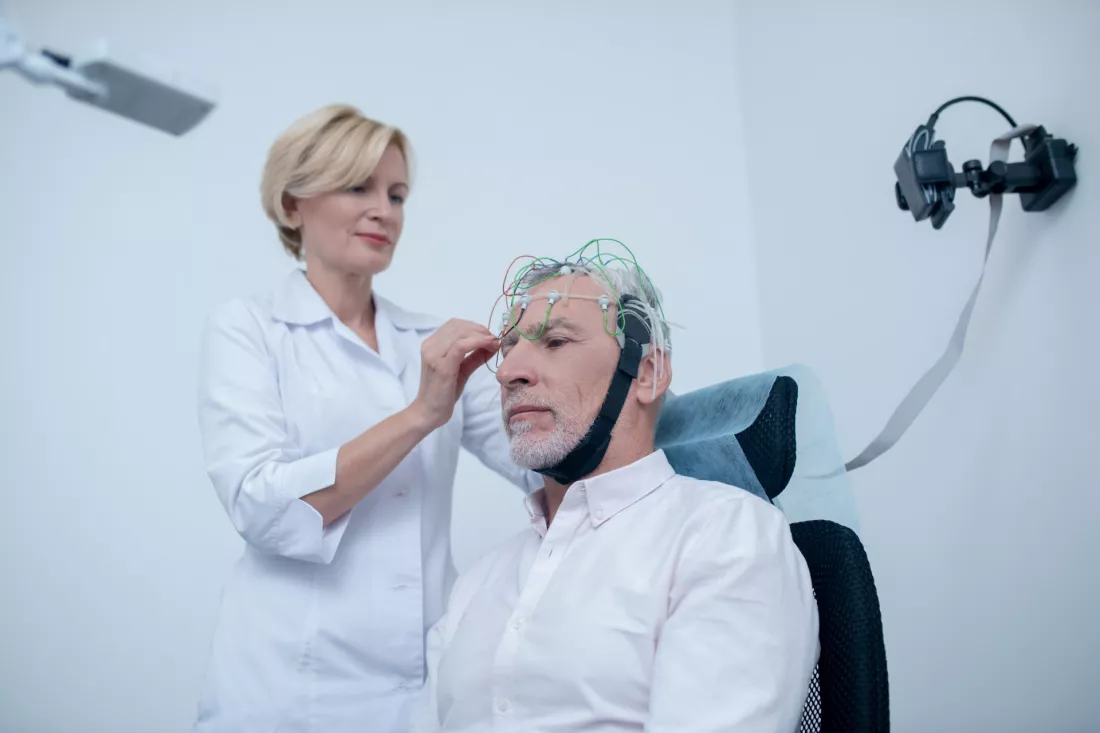
More than 10 million Europeans live with mild cognitive impairment, and about half of them will develop dementia within five years. Yet clinicians still lack an affordable way to tell who is most at risk. The EU-funded AI-Mind project brought EEG recordings, blood biomarkers and cognitive assessments together in an AI-based decision-support system — and at the end you can check whether you caught the key details of the story.
Mild cognitive impairment sits between normal ageing and dementia. Memory or concentration decline more than age alone would explain, yet everyday life still goes on fairly normally. More than 10 million Europeans live with it.
The problem is that this group is very mixed. Around 50 % will progress to dementia within five years, while the rest will not. Clinicians currently lack affordable tools that would identify, early enough, the people at highest risk who could benefit from preventive measures.
Instead of relying on a single biomarker, the EU-funded AI-Mind project partnered with leading hospitals and research centres in Spain, Finland, Italy and Norway to build a multimodal database. Its AI-based decision-support system combines:
Each source says something different about a patient, which is why the system reads them together.
The first tool, the AI-Mind Connector, analyses brain connectivity from standard EEG recordings. The question is not simply whether the brain is active, but how its different areas communicate with one another.
“Using advanced signal processing and AI, the ‘AI-Mind Connector’ spots subtle changes in communication between brain areas that can appear years before symptoms develop,” explains project coordinator Ira Haraldsen of the Cognitive Health Research group at Oslo University Hospital.
The second tool, the AI-Mind Predictor, combines EEG data with cognitive test results, genetic data, blood biomarkers, demographic information and clinical history. Its machine learning algorithms were trained on a prospective longitudinal cohort of people with mild cognitive impairment: more than 1 000 participants and roughly 4 000 clinical visits. From these, the models learn complex relationships linked to future clinical outcomes.
The results were encouraging. “Brain network connectivity measures complemented emerging blood biomarkers even better than expected, heralding opportunities for more precise risk stratification,” says Haraldsen. Risk stratification here simply means sorting patients by how likely they are to get worse.
A medical AI tool has to be legal as well as accurate. The team aligned its work with General Data Protection Regulation principles, FAIR data standards, the Medical Device Regulation and the AI Act. “Thus, it created one of Europe’s first clinically oriented AI ecosystems designed with regulatory readiness from the outset,” Haraldsen adds.
The consortium also produced a publicly available early health technology assessment framework. It helps healthcare providers and policymakers judge whether a new technology brings enough improvement to justify its cost.
Beyond its algorithms, AI-Mind established reusable infrastructure for multimodal health data, automated EEG processing, synthetic data generation, quality-controlled AI development and regulatory-compliant software pipelines. These resources already support other European initiatives, including eBrain-Health, FluiDX-AD and TEF-Health. A dedicated spin-off company is taking the work towards clinical use and commercial deployment.
AI-Mind shows that early detection of dementia risk can rely on tests that clinics already use, as long as they are combined intelligently. If such tools reach everyday practice, care could shift from diagnosing people once symptoms appear towards precision prevention and interventions tailored to each patient.
5 questions · one minute


 EN
EN 
 CS
CS DE
DE ES
ES FR
FR HU
HU IT
IT PL
PL PT
PT РУ
РУ SK
SK TR
TR УК
УК AR
AR 中文
中文